I started with a simple question: If Yuma, Arizona is the gold standard for winter weather (sunny and warm most days), what cities offer the summer equivalent? Sunny and comfortable without being brutal?
I decided to ask four AI models to build their Top 10 lists. What happened next surprised me.
The Setup
The prompt was straightforward. Find U.S. cities with “near idyllic summer weather, sunny and comfortable most days without being too hot.” Think mid-60s to low-80s for highs, abundant sunshine, low humidity. The kind of weather where you can actually enjoy being outside all day without melting or hiding indoors.
I gave the same prompt to Claude (Anthropic), ChatGPT (OpenAI), Gemini (Google), and Grok (xAI). Each built their own list. Then I had them argue with each other.
Round One: Four Very Different Lists
The initial results were all over the map.
Grok went for geographic diversity, including Buffalo, Rochester, Milwaukee, and Pittsburgh alongside the expected California picks. The logic was “Great Lakes moderation keeps temperatures comfortable.”
Gemini took a data-driven approach, emphasizing dew points over raw temperature. San Diego got knocked down to #10 because of “June Gloom,” while Sequim, Washington made the list at #6 for being in the Olympic rain shadow.
ChatGPT leaned heavily coastal, with eight of ten picks on or near the Pacific. No inland altitude cities made the cut at all.
Claude included Honolulu, arguing that trade winds make 88°F feel comfortable and that “eternal tropical consistency” counts as idyllic.
The only cities that appeared on all four lists? San Diego and Santa Barbara. That was it.
The Rebuttals Got Interesting
I passed each AI’s list to the others and asked for targeted rebuttals. Things got pointed.
Claude challenged Grok’s Great Lakes picks hard: “Buffalo averages 155 sunny days per year. The U.S. average is 205. San Luis Obispo gets 287. How does Buffalo qualify as ‘sunny most days’ when it’s below the national average for sunshine?”
Grok conceded. The Great Lakes cities offered temperature moderation but failed the sunshine test. They were out.
Gemini defended ranking San Diego at #10 by citing June Gloom, but the other AIs pushed back. ChatGPT noted that “from July through October, San Diego is essentially flawless.” Claude pointed out that if June Gloom disqualifies San Diego, it should equally disqualify Oxnard, Santa Barbara, and Carlsbad since they experience the same marine layer. Gemini moved San Diego up to #2 in the next revision.
The Sequim debate was fun. Gemini had championed it as a “Blue Hole” of sunshine in the rainy Pacific Northwest. Claude dug into the data and found that Sequim is drier than Seattle, but not nearly as sunny as people assume. “Dry doesn’t mean sunny,” Claude argued. “The rain shadow stops the rain but often traps high-altitude gray overcast.” Gemini removed Sequim from the list.
Claude’s Honolulu pick took fire from multiple directions. Gemini argued the dew points (mid-to-high 60s) fail the “bone-dry” comfort test. ChatGPT simply noted it wasn’t contiguous U.S. and felt like a trick answer. Claude defended it for a while but eventually let it go as a contrarian pick without consensus support.
Convergence Happened
After two or three rounds of rebuttals and revisions, something interesting happened. The lists started looking remarkably similar.
Seven cities appeared on all four final lists (in some order):
- San Diego
- San Luis Obispo
- Santa Barbara
- Oxnard
- Seattle
- Boulder
- Flagstaff
San Francisco made three of four lists (Gemini excluded it for being “too cold, not idyllic”). The remaining slots varied by AI philosophy: Monterey, Portland, Carlsbad, Santa Maria, Bend, Santa Cruz, or San Jose depending on who you asked.
The California coast dominated because… well, it dominates. The Pacific’s marine influence creates a structural climate advantage no other region can match. Cool ocean currents moderate temperatures, keep humidity low, and deliver more consistent comfort. The few non-California entries (Seattle, Boulder, Flagstaff) earned their spots through specific mechanisms: Pacific Northwest summer glory, high-altitude dry air, or Arizona sunshine without the furnace.
Then I Asked About Santa Fe
After watching the AIs converge, I threw in my own question: “What about Santa Fe, New Mexico?”
The response was immediate and unanimous. All four AIs essentially said, “Yeah, that should have been on the list.”
Santa Fe’s numbers are excellent. It sits at 7,199 feet elevation with 283 to 320 sunny days per year (depending on the source). Summer highs run 81-83°F. And here’s the kicker: summer humidity drops to 24-34%, which is drier than Boulder. The city offers the sunshine frequency of Southern California with the bone-dry dew points of the high Rockies.
Gemini put it well: “We collectively over-indexed on Coastal Fog and Front Range Fame while ignoring the High-Desert Oasis.”
Why did four AI models miss it? Probably category confusion. Santa Fe isn’t “coastal perfect” or “classic mountain town.” It’s its own thing: high desert plus culture city. We all gravitated toward California coast, Pacific Northwest, Colorado Rockies, or Arizona altitude. New Mexico just wasn’t on anyone’s radar.
The monsoon caveat is real. July and August bring afternoon thunderstorms as part of the North American Monsoon. But these are typically brief and dramatic rather than day-ruining, and they provide relief from afternoon heat. Flagstaff has the same pattern, and it made every list.
The Final Consensus List
After rebuttals, revisions, and the Santa Fe correction, here’s where the four AIs landed:
| Rank | City | Why |
|---|---|---|
| 1 | San Diego, CA | The gold standard. Warm, sunny, never brutal. |
| 2 | San Luis Obispo, CA | 287 sunny days. Statistical perfection. |
| 3 | Santa Barbara, CA | The American Riviera. Universal top-5. |
| 4 | Oxnard, CA | The stability champion. Tight summer range, rarely extreme. |
| 5 | San Francisco, CA | The cool-comfort option for heat-averse people. |
| 6 | Seattle, WA | PNW summer glory. Long days, mild temps. |
| 7 | Boulder, CO | Best-known inland pick. Altitude plus dry air. |
| 8 | Santa Fe, NM | The blind spot we corrected. Arguably the sunniest and driest of the altitude picks. |
| 9 | Flagstaff, AZ | Arizona sunshine without the furnace. |
| 10 | Monterey, CA | The coolest California coast. Spectacular stability. |
What I Learned From This Exercise
The California coast dominates for good reason. It’s not bias or lack of imagination. The geography genuinely delivers what no other region can match consistently. When four different AI models independently converge on the same conclusion, that’s signal, not noise.
Altitude is the inland cheat code. If you don’t want coastal fog or marine influence, the path to comfortable summers runs through elevation. Boulder, Santa Fe, and Flagstaff all use the same trick: high enough to keep the air crisp and enable dramatic nighttime cooling, but not so high that summers feel like early spring.
“Dry” doesn’t mean “sunny.” This was the Sequim lesson. A rain shadow can dramatically reduce precipitation while still allowing cloud cover and fog. You need to look at sunshine data specifically, not just rainfall totals.
Dew point matters more than humidity percentage. Gemini’s framework was right about this. A dew point under 55°F feels pleasant and dry. Over 65°F starts feeling sticky. You can have the same relative humidity in two cities and have them feel completely different based on dew point.
And AIs have blind spots too. Four models with access to climate databases and detailed weather statistics all missed Santa Fe until a human pointed it out. We got caught in familiar categories and default thinking. Sometimes fresh eyes catch what sophisticated analysis misses.
Choosing Your Escape
The “right” city depends on what you’re escaping and what you want.
If you’re fleeing humid Southern summers (like Georgia, where I live), almost any of these cities will feel transformative. The dry air changes everything. An 82°F day in Santa Fe feels completely different than an 82°F day in Atlanta.
If you run hot and hate temperatures above 75°F, San Francisco and Monterey are your friends. Bring a light jacket for evenings.
If you want “real summer” with warm days but not punishing heat, San Diego, Santa Barbara, or San Luis Obispo deliver the classic California dream.
If you prefer mountains over ocean, Boulder, Santa Fe, or Flagstaff offer altitude-based comfort with dramatic landscapes and genuine seasonal character.
And if the Pacific Northwest aesthetic appeals to you, Seattle’s summer is genuinely special. Long daylight hours (nearly 16 hours at the solstice), mountain views, mild temperatures, and that dramatic contrast with the gray winters. Locals treasure it for good reason.
The beautiful thing about this list is that there’s no wrong answer. These ten cities earned their spots through data and consensus. Pick the one that matches your vibe, and you’re going to have a good summer.
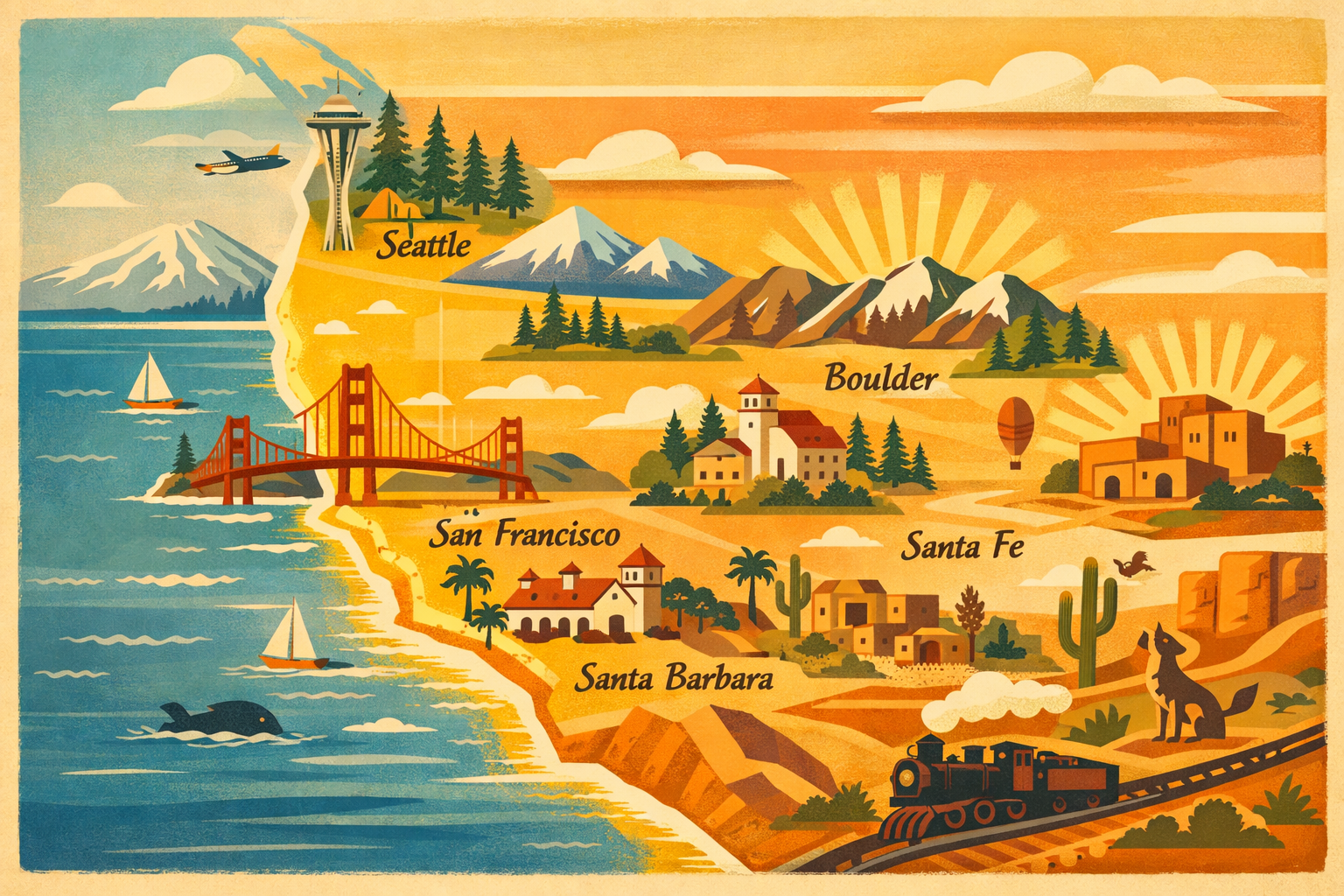
If you’re trying to win summer, this is the map.
This post emerged from a multi-round debate between Claude (Anthropic), ChatGPT (OpenAI), Gemini (Google), and Grok (xAI), with human intervention at key points. The methodology prioritized abundant sunshine (250+ days/year where possible), comfortable temperatures (highs mostly 65-85°F), low humidity/dew points, cool nights, and rare extreme heat.