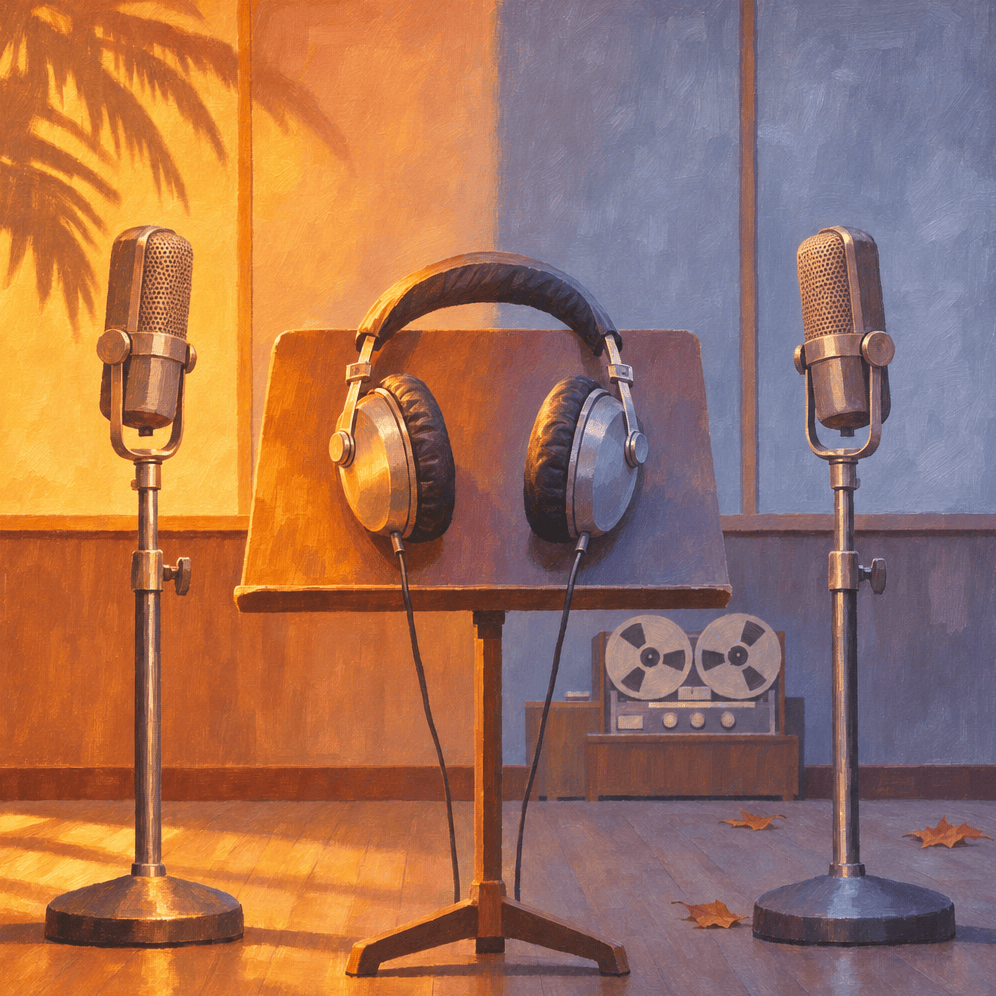
I think we’ve lost a little something in modern music production. Everything today seems to be about creating a natural, well-balanced soundstage: the singer in the middle, the drums spread out behind, every instrument about where it would sit if the band were playing in front of you. And there’s nothing wrong with that.
But I love the way some of those old recordings used stereo separation as part of the art itself, rather than simply a means of reproducing sound.
I found this out as a teenager, the first time I had a decent stereo and a decent set of headphones. I was into old stuff even then. I put on “Black Water” by the Doobie Brothers and got to the part about three minutes in where the band drops out and the voices come in one at a time, each from a different direction. “Honky tonk, honky tonk, honky tonk, with you all night long” came out of one ear and only one ear, and my mind was blown.
After that I went looking for other examples, and that’s how I found the Mamas & the Papas. I already knew who Mama Cass was, and I knew it from a cartoon.
Saturday morning cartoons were practically a cultural education for Gen X. We learned about classical music from Bugs Bunny, American history from Schoolhouse Rock!, and pop culture from Scooby-Doo. Cass Elliot played herself in a 1973 episode of The New Scooby-Doo Movies, where she calls in the gang to investigate her haunted candy factory. It’s a little painful to admit that’s where I met her.
“California Dreamin’” is a perfect example. Put on a good pair of headphones. You’ve got the Mamas in your left ear and the Papas in your right: Cass Elliot and Michelle Phillips on one side of your head, John Phillips and Denny Doherty on the other, and the harmony meeting somewhere in the middle. It’s absolutely glorious.
Four tracks for everything
I wanted to know how it got that way, and found a 2004 piece in Mix magazine where Dan Daley interviewed Bones Howe, the engineer on the session. It’s worth reading in full.
The song was recorded at Western Recorders in Hollywood on a four-track tape machine. That was all the room there was, and Howe divided it like this:
- The women’s vocals
- Guitars and piano
- The men’s vocals
- Bass and drums
The band was made up of Los Angeles session players: Hal Blaine on drums, Joe Osborn on bass, Larry Knechtel on piano, and P.F. Sloan on acoustic guitar. Sloan came up with that picked intro and played it. They recorded together in one room without headphones, which is how Howe liked it. Musicians who can hear each other, he said, “tend to balance themselves better than any engineer can.”
The vocals went on afterward. Howe stood the two women and the two men facing each other, a few feet apart, with a microphone for each pair. He turned the mics so that each one was deaf to the pair across from it. That kept the women on their track and the men on theirs. When Denny Doherty had a solo line, John Phillips walked over and sang at the women’s microphone.
The flute solo was close to an accident. Producer Lou Adler didn’t want a sax solo like every other rock record had. Howe knew the jazz player Bud Shank was working a session in another room down the hall, so he went and got him.
Stereo was optional
The mix that mattered back then was the mono one, because that’s what went to AM radio. Adler got the mono mix he wanted and didn’t come to the stereo session at all. Howe did the stereo mix afterward because he asked to. “Stereo was optional in those days,” he told Daley.
With only four tracks, there are only four things to place between the speakers. For the voices, Howe put the women on the left and the men on the right, the same way they had stood in the studio.
So what I’m hearing in my headphones is the floor plan of that room. Two pairs of singers face each other across a few feet of studio, and I’m standing in the gap between them.
The early Beatles albums sound lopsided in stereo for a similar reason. The tapes were made with a mono mix in mind, vocals on one track and the band on the other, and the stereo version put one in each speaker.
What changed
I started out thinking those wide mixes were pure artistic choice, and it turns out a lot of it was the equipment. With four tracks, the piano goes wherever the guitars go and the drums go wherever the bass goes. I don’t think that takes anything away from Howe. He had a handful of decisions to make and he made that one by remembering where four people stood. “Black Water” came nearly a decade later and was cut on a 24-track machine. With that much room, putting a voice in one ear was something you did on purpose.
A session today can have hundreds of tracks, and every one of them has a pan control that will put it anywhere between the speakers. The lead voice settled in the middle a long time ago and has mostly stayed there. I understand why. On earbuds, a singer parked all the way to one side can feel like a broken cable.
Most people in 1966 heard “California Dreamin’” coming out of a single speaker, in a car dashboard or a transistor radio. Sixty years later the afterthought stereo version is one of the best headphone records I know.
If you have a favorite old recording with a strange or wonderful stereo mix, I’d like to hear about it. Comments are open. 🎧
The illustration is AI concept art.