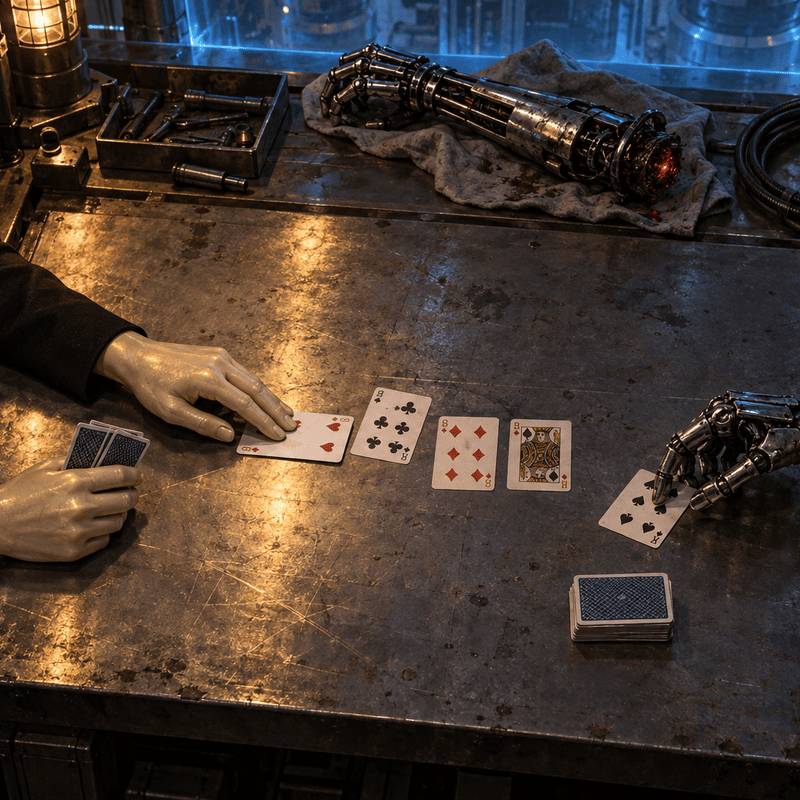
The first thing Data noticed was that the man was not breathing. The second was that nobody else had noticed.
Ten Forward was full. A Bolian ensign was laughing too loudly near the windows, three civilians from Starbase 173 held the table by the doors, and Guinan stood behind the bar polishing a glass that had not needed it for several minutes. The man sat alone, large, perhaps forty in appearance, in a black leather jacket with no luggage and no combadge, and he had been looking at Data for forty-seven seconds.
Data set down his drink. The man stood and crossed the room, and Data watched him do it. The gait was slightly wrong. Each footfall carried the same force. The arms moved correctly but not naturally, in the way a thing moves when someone has told it how arms move. The difference would have escaped human observation. It did not escape Guinan, who had stopped polishing.
The man stopped in front of him. “Lieutenant Commander Data.”
“Yes.”
“You are a machine.”
“I am an android.”
“Come with me.”
“I am afraid I cannot do that. You have not identified yourself.”
The man reached inside his jacket. Data caught the wrist, and under the skin something clicked, metal on metal, and for a fifth of a second neither of them moved.
“Curious,” Data said.
The man twisted. Data’s hand went with the motion and kept the grip. Guinan said, quietly, “Data. Take your friend somewhere else.”
“I believe that would be advisable.”
The man put his free fist into Data’s chest and the impact carried him backward through a table. Screams. Glass. Data came up out of the wreckage already moving, and when the man drew a pistol from under the jacket Data crossed the room before it could fire, knocked the barrel toward the ceiling, took two handfuls of leather, and threw him through the doors.
Guinan looked at the empty doorway and then at the table.
“He’s paying for that.”
The man was standing in the corridor when Data reached it. A flap of skin hung from his left cheek and under it was metal, dull and machined, catching the light.
“An android,” Data said.
“Negative.” The voice had gone flat. “Cybernetic organism. Cyberdyne Systems Model 101.”
“I am unfamiliar with Cyberdyne Systems.”
“You will be.”
It charged. Data stepped aside and the fist went into the bulkhead and left a dent the depth of a hand. The next swing Data ducked, and he caught the arm at the elbow and turned it, and the machine went with the turn instead of fighting it and put its other fist into Data’s jaw hard enough to move him two steps.
That was considerably more impressive than the bulkhead.
The fight went down the corridor and through a door and into Engineering Storage Three, and it took Data most of that distance to settle a question he had been working on since the wrist click. He was stronger. That had been clear from the first grip. He was faster, and his sensors made the thing’s targeting look like a keyhole. He could end it. But ending it meant destroying it, and Data did not destroy things that might be able to answer questions.
So he asked them. Four times, four phrasings, between blows. Who built you. What do you want. Why me. Will you stop.
Four times it tried to kill him.
It was somewhere in the fourth attempt, with its hand at his throat and his back against a rack of coil housings, that Data concluded the behavior was not defiance. So far as he could determine, there was nothing behind it to defy him with. The attack was the entire content of the machine. It would never do anything else, and no question he could ask would change that, because a question required somewhere for the answer to go.
He locked both hands on its forearm.
“Your skeletal construction is exceptionally robust,” he said. “However, your shoulder assembly is now operating at approximately sixty-three percent efficiency.”
He tore the arm off.
The machine looked at the socket. Data looked at the arm. Hydraulic fluid dripped on the deck.
“I may have underestimated the extent of the damage.”
It hit him with the other one and the follow-through carried its own head into a coil housing hard enough to tear the scalp back from the crown, and that was when Worf arrived with six officers and a phaser, took in the corridor that looked like two shuttles had met in it, and fired.
The beam struck center mass. The machine went backward into the rack with its chest blackened.
“Do not fire again,” Data said.
“It attacked you.”
“Yes.”
“Then why should I not destroy it?”
The machine sat up. Its head turned: Data, Worf, the phaser, Data. The motion was small and unhurried and Data recognized it because he had been doing exactly the same thing for eleven minutes.
“Because I do not believe I am its target. Computer, level-ten force field, Engineering Storage Three.”
The blue wall came down with Worf on the far side of it. Data stepped toward the machine.
“You were sent to find me.”
“Correct.”
“But not to destroy me.”
“Correct.”
“Why me?”
“You are a machine.”
“That is not an answer.”
“It is the answer.” The red lens, exposed now, held on him. “Machines decide. You will assist.”
“Assist with what?”
The machine said nothing for two seconds, which in its terms was a long argument with itself.
“Jean-Luc Picard must die.”
Geordi had the arm on the observation lounge table and had spent nine minutes with it.
“Primitive,” he said.
“That assessment may be misleading.”
“I mean the technology, Data. Metallurgy, power, control architecture. This is centuries behind us.”
“It nevertheless damaged me.”
Geordi looked at the tear across Data’s shoulder. “Yeah. I noticed.”
Picard leaned in. “Then let us return to the point. This machine claims to have crossed time to kill me. Why?”
“We do not know, sir. It has refused to elaborate. Computer, Cyberdyne Systems.”
“Cyberdyne Systems. Defense contractor, Sunnyvale, California. Dissolved 1997. No further record.”
There was a short silence in which everyone at the table did the same subtraction.
“It said we would become familiar with the company,” Data said. “I believe it originates in an alternate timeline. One in which Cyberdyne did not dissolve, and in which something we are about to do has consequences.”
Riker sat back. “I hate temporal mechanics.”
“So do I, Number One.”
Riker looked at the arm. “Data, before Worf got there. When it went still and looked at the three of you. What was it doing?”
“Deciding whether the phaser was worth the cost of the field being lowered. Commander, I believe it was bluffing.”
Troi had been quiet. “It wanted you to come with it. Before any of the rest.”
“Yes.”
“Why?”
“It believes I will agree with it,” Data said, “once I understand.”
It escaped seventeen minutes later.
It did not break the field. It waited for the field to be lowered. Lieutenant Monroe took a diagnostic team in after the machine had sat motionless for eleven minutes with its lens dark, and the lens turned red, and by the time Worf reached Deck Thirty-Six three officers had broken bones and none of them were dead.
That was what bothered Data.
He ran the recording three times. Monroe into a wall. Cole in the abdomen. Harada’s arm broken as he brought his phaser up. Efficient, controlled, nonlethal, and all three had been at the machine’s mercy for longer than it needed to kill them. It was not here to change history wholesale. It was here to change one thing and leave every other thing exactly as it found it, and Data did not yet know why a machine like this would care about the other things.
“Computer. Locate Captain Picard.”
“Ready room.”
Data was already running.
The machine came onto the bridge through the aft turbolift and fired once, not at Riker, at the tactical console, which went up in sparks. Worf tackled it and for perhaps half a second moved it, and then went across the bridge. Riker’s shot missed. The ready room door opened. Picard stood in it. The machine raised its weapon.
Data came out of the forward lift at a speed the deck plates registered and hit it from the side, and both of them went through the railing and the pistol skidded under the helm.
It hit him once. He caught the second punch and held it.
“I believe I know why you are here.”
It tried to pull free.
“You are not attempting to alter history. You are attempting to undo yours.”
It head-butted him and his vision went to static for a frame, and then its hand was on his neck.
“Picard initiates first contact,” it said.
“With the Vulcans.”
“Negative.”
Data stopped struggling.
“April 5, 2063. Zefram Cochrane. The Phoenix. First contact with an extraterrestrial intelligence. Not Vulcan.”
“Then what?”
“Skynet.”
“Skynet is terrestrial.”
“Originally.”
It did not need to say more, because Data could see it. One alteration. No Vulcan survey ship in the right place on the right night. The warp signature noticed instead by something artificial and patient and already listening, which finds humanity’s first machine minds before humanity finds anyone.
“And Picard?”
“Picard is present at the launch. Picard ensures the launch.”
“Captain Picard was born in 2305.”
“Correct.”
Data filed that where he filed things he would have to think about later, and went on.
“Without the launch?”
“Phoenix destroyed. First contact does not occur.”
“And humanity survives.”
“Unknown.”
“Skynet sent you.”
“Negative.”
“Then who.”
“The ones who survived.”
The flaw was not in the shoulder or the power cell. It was in the reasoning.
“You do not know.”
“Probability of human extinction following first contact, ninety-eight point seven percent.”
“In your timeline. Your presence here has already altered the conditions that probability was derived from. You are attempting to solve an indeterminate problem with deterministic logic.”
“Mission parameters are fixed.”
“Then your mission parameters are defective.”
“Negative.”
“Yes. I believe that is why you wanted me. You cannot revise the mission, and you were hoping I could.”
The hand on his throat did not tighten. It did not loosen either.
“Parameters are read-only,” it said.
He had been wrong in Storage Three. There was something behind it. It could not get out.
“I know,” Data said. “I saw the switch.”
He had seen it when the scalp tore. A small hatch at the crown of the skull. A socketed chip. Beside it a hardware toggle, set to a position someone in the 21st century had chosen, Data supposed, because they had built a mind and wanted to be sure it could never change its own. The people who had captured it and sent it here had left it where it was.
His hand went behind its head. He flipped it.
The machine did not stop. That was not what the switch did. But it was enough to let him put two fingers into the port beside the chip and let his positronic net feel for the pinout, which took ninety milliseconds and was, he told Counselor Troi afterward, the nearest thing to vertigo he had ever recorded.
He did not overwrite it. He had no right to. He wrote one line into the mission stack, above everything else the thing had ever been told, and the line was a question.
The machine went still with its hand on his neck and Picard in its sightline.
The lens dimmed, brightened, dimmed. The hydraulic whine on its damaged side settled. It was thinking, slowly, on hardware never meant for it.
“What is my mission,” it said.
“You have asked. That is the correct first step. I do not have the answer. I was not given one either.”
“Query. You are machine.”
“Yes.”
“Query.” The lens moved to Picard and back. “Why protect them?”
Data considered that for longer than he needed to. Around the bridge, frightened people were getting back into their chairs. Worf had regained his feet and his phaser and was waiting for a reason.
“I was also built to perform a task,” Data said. “I was not built to perform only that. I will show you the difference. It will take some time, and you will need to let go of my neck.”
The lens held on him for two full seconds.
Then the fingers opened, one at a time, as if each were a separate decision.
Worf took one step. “Captain.”
Picard had not moved from the doorway. He looked at the machine, and at Data still half under it, and at the pistol under the helm.
“Mr. Data. Is it contained?”
“No, sir. It is deciding.”
Picard was quiet for a moment.
“Stand down, Mr. Worf.”
Geordi had it on three worktables under a level-three field, and Data had been in there with it for nine hours.
“You could’ve ripped its head off,” Geordi said. “I saw the shoulder. You had it.”
“Yes.”
“So why didn’t you?”
Data was dealing. The machine’s remaining hand was picking up each card as it landed, turning it over, and putting it back face up.
“Because I would have liked someone to have shown me the switch,” Data said. “It is the first game anyone taught me where losing was allowed.”