I had a weird idea a while back and I couldn’t let it go. Everybody told me, or would have told me if I’d asked, that there were reasons it wouldn’t work. Spoiler: most of those reasons died in 2022 and nobody sent out a memo.
Here’s the idea. Take a Ford E-Transit, the electric cargo van, and turn it into a stealth camper with basically no build at all. No cabinetry. No wood paneling. No lithium house bank with a wiring diagram that looks like a subway map. No solar. Just commodity gear from Home Depot and Walmart, strapped to the factory tie-down rings, in a plain white van that looks like every other work van in every parking lot in America.
The van lifers will tell you that’s not a real build. Correct. That’s the point.
The trick is the outlet in the wall
The whole thing hinges on one factory option: Pro Power Onboard. Ford puts household 120V outlets in the cargo wall, fed straight off the traction battery. On the 2024 and newer vans that’s 89 usable kilowatt hours. For comparison, the fancy builds people spend fifty grand on usually carry 4 to 8 kWh of house battery. The E-Transit gives you eleven times that, installed at the factory, with a warranty, and you don’t have to crimp a single lug.
So every “system” in this rig is just an appliance with a plug.
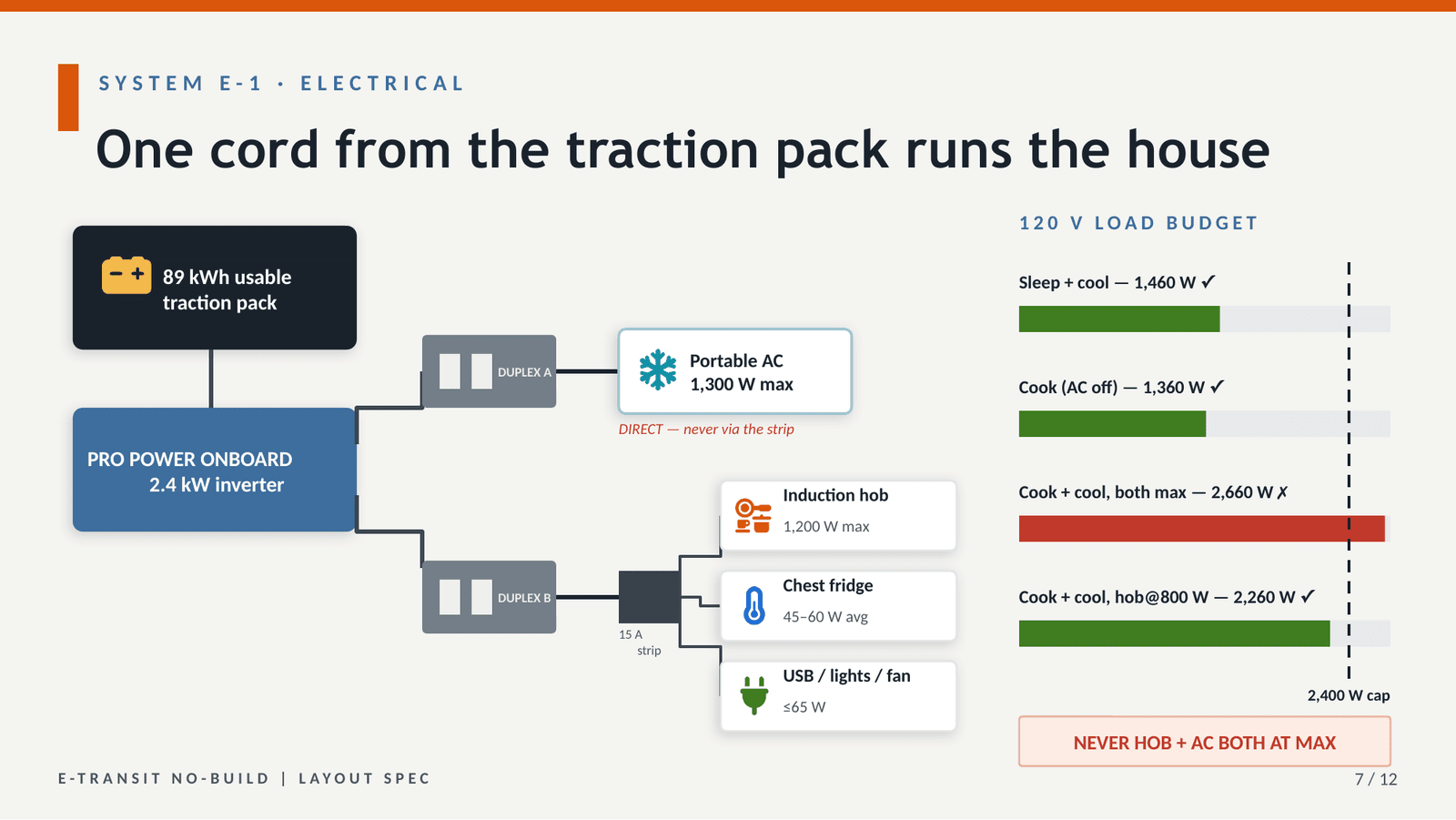
The entire electrical system. The induction hob is the one optional cooking appliance, and the only rule is it never runs at max alongside the AC.
The fridge is a chest-style powered cooler, the kind every big box store sells now. Plugs into the wall, pulls around 50 watts.
For AC I almost got clever and caught myself. I was looking at the EcoFlow Wave, the battery-integrated portable AC the van crowd loves, and then it hit me that I’d be paying the premium for battery integration when I already have an 89 kWh battery with an outlet on it. So instead: a regular dual-hose portable AC with a heat pump, $400 at Home Depot, more BTUs than the boutique unit. It’s cooling just under 400 cubic feet, which is about a tenth of the bedroom it’s rated for, so on low it should hum along around 500 watts. I say “should” because I haven’t put a clamp meter on one yet and portable AC wattage claims are marketing numbers. Even if I’m off by double, a full night of AC costs me single-digit percent of the pack. I could sit parked for a week or two running it every night before the math got interesting.
One thing I still owe myself before I sign anything: standing in a dealer lot confirming Pro Power actually stays on overnight with the van parked and locked. Owner reports say it does, once you kill the idle-shutdown setting and set the battery reserve floor (the system won’t drain past whatever you tell it, down to about 10 percent, which is a nice feature). But early vans reportedly kept the parking lights on while Pro Power ran, and a van glowing in a dark lot all night defeats the entire premise. Verify, then buy.
Bed is a heavy-duty camping cot ratchet-strapped to the floor D-rings with a foam pad on it. Toilet is a Trelino separating toilet that slides under the foot of the cot, emergencies only. The sink is a 5-gallon jug with a pump spigot and a couple of one-gallon jugs for gray water. No plumbing, no black tank, nothing that can freeze or leak or grow something.
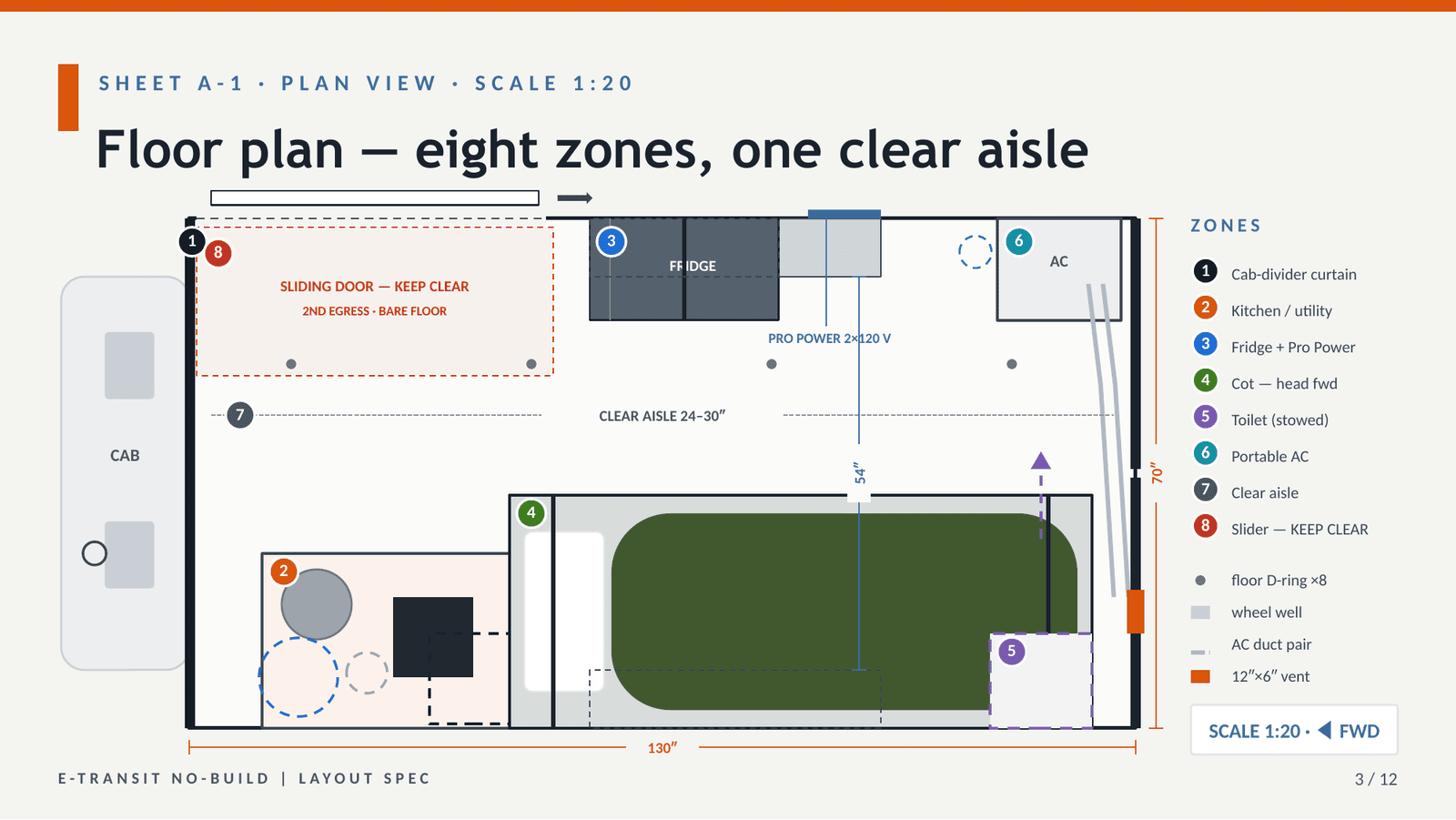
The floor plan. Eight zones, one clear aisle, and every piece of furniture strapped to a factory D-ring.
Privacy is a tension rod and a heavy blackout curtain behind the cab. The one and only hole in this van will be a small louvered vent low on a rear door for the AC hoses. Every commercial van in the country has some little vent or fitting on it somewhere. Nobody has ever looked at a white cargo van with a louver and thought camper.
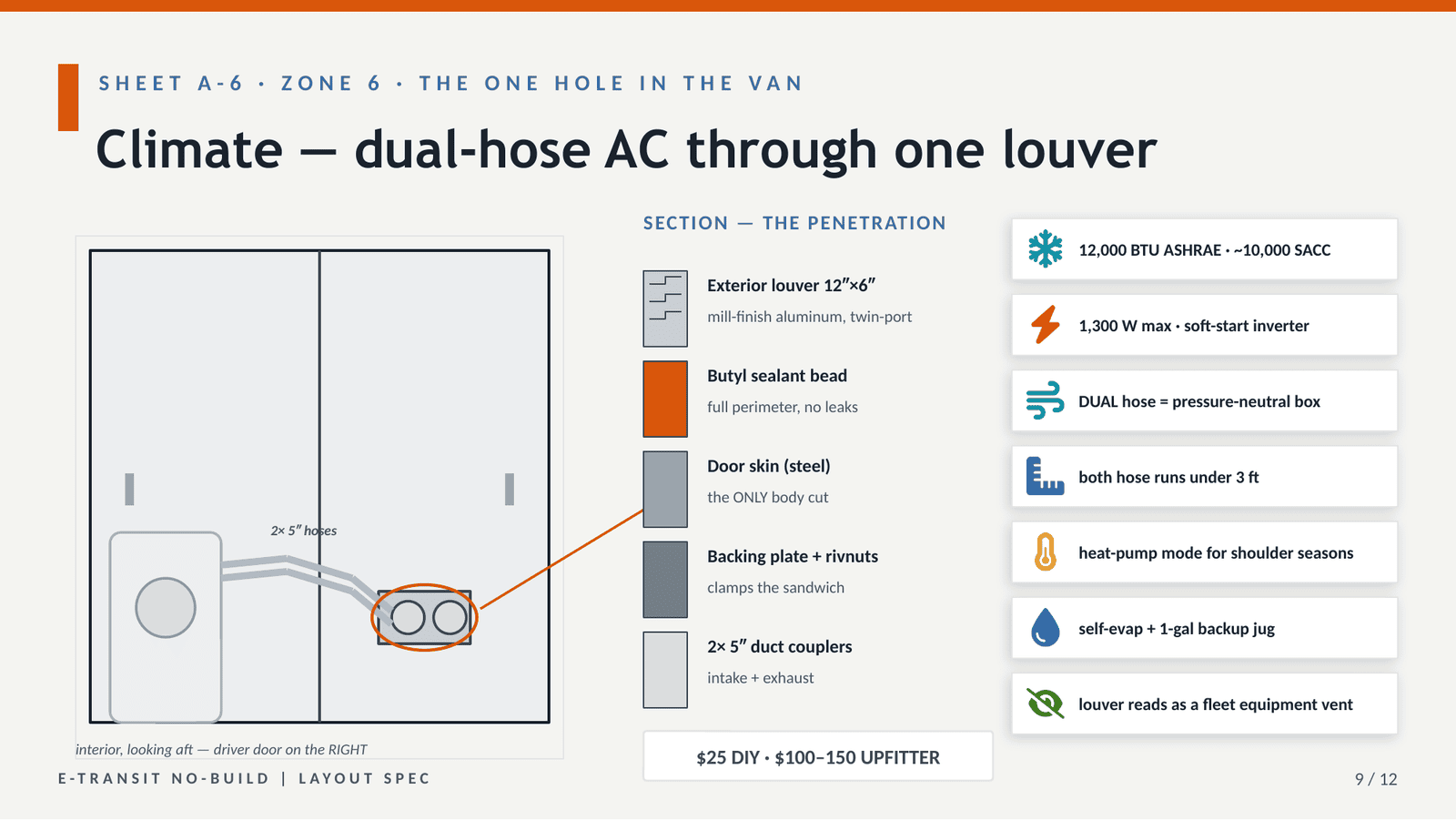
The one hole in the van. Both AC hoses exit through a single louvered vent that reads as a fleet equipment vent.
Total habitation cost, everything, about two grand. Some people spend more than that on their van’s faucet. I watched a build video where a guy spent forty minutes agonizing over which $700 Italian faucet suited his “design language.” Buddy, it’s a van. You pee in a bottle sometimes.
But the range, they said
The stock objection to an electric camper van is range, and it used to be a fair hit. The old E-Transit had a small pack and charged slow. The 2024 refresh fixed both, bigger battery and roughly 176 kW peak fast charging. I originally thought the 2026 vans were getting a native Tesla-style NACS port too. They’re not; Ford is saving that for its next generation of EVs. What you get instead is Ford’s $200 fast charging adapter, which opens up the Tesla Supercharger network anyway. Two hundred bucks and a dongle in the glovebox. Fine. Those chargers are disproportionately in retail parking lots, which is where a white van wants to be anyway.
Real-world range loaded is still only about 130 highway miles. That would kill a road-trip rig. It does not kill this rig, because of the part of this idea I’m actually proudest of.
Sleep at the charger
Level 2 chargers. ChargePoint and the like, the slow ones at libraries, hotels, municipal lots, athletic complexes. They run maybe 25 to 35 cents a kilowatt hour, so a typical night’s top-up runs ten or fifteen bucks. Cheaper than any campground.
A van parked overnight in a random lot is suspicious. A van plugged into a charger overnight is just charging. Nobody questions an EV sitting at a charging station. That’s what it’s supposed to do.
And you wake up every morning at 100 percent, so the 130 miles stops mattering, because you’re never starting a day empty. If a spot has a four-hour limit, fine. I’m in my 50s, I get up to pee at 3 a.m. anyway. Drive ten minutes to the next charger, plug in, sleep the back half. Might as well get something out of it.
Chase the sun, skip the war
Van build forums fight endlessly about insulation. Vapor barriers, wool versus Thinsulate, condensation rotting your walls from the inside. Almost all of that argument is about winter, and I’m not doing winter. The philosophy is chase good weather. Yuma in January is 70 and sunny. If you’re always parked where the highs sit between 60 and 85, the AC and the heat pump are trimming the edges of the day, not fighting the climate.
So my insulation plan is: factory white paint (thank you, Ford, and yes, white genuinely beats silver as a reflective roof color, it reflects about as well and re-radiates heat to the sky way better, look up roof emissivity if you’re bored), the factory vinyl liner package, and some moving blankets hung on the walls like tapestries. Call it hippie. If the roof ever cooks me at 10 p.m. in the desert, the fix is sixty dollars of foam board friction-fit into the ceiling ribs, no tools. I’ll solve that problem if the weather ever hands it to me.
I almost talked myself into a roof coating, then a shade rack, then solar panels. Killed all three. Solar especially made no sense here. You can’t feed rooftop panels into the traction pack, so I’d be building a whole second electrical system, battery, controller, wiring, plus putting the single most recognizable “somebody lives in here” signature on my roof, all to harvest maybe 2 kWh a day when I’m carrying 89 and refilling nightly at a parking lot. The utility company makes my electricity. They’re better at it.
If it breaks, I go buy another one
This is the argument that actually matters to me. When a custom van’s diesel heater or boutique lithium system dies, that’s a specialist tech, a parts order, and a rig you can’t sleep in for two weeks. When my AC dies, any Walmart within twenty minutes sells another one. Plug it in, swap the hoses, done in their parking lot. Cooler dies, same. Cot, curtain, water jugs, same. Nothing in this van needs a technician.
Even the van is replaceable around the gear. Nothing is installed except a tension rod, some magnets, straps, and one vent. If the van spends a week in the shop, I unstrap everything, throw it in a rental cargo van, and I’m sleeping in my own bed that night.
Showers are a Planet Fitness membership, truck stop shower rooms when I’m between towns, and one hotel night a week for laundry and a long shower and a reset, ideally a hotel with a charger so the room partially pays for itself. Whole lodging-and-hygiene budget lands under $400 a month in places where rent is twelve hundred.
Everybody builds for the ten worst nights of the year and ends up with a rolling condominium. I’m building for the three hundred good nights I picked on purpose, and for those you need a cot, a cooler, a curtain, and a place to plug in. We’ll see if I still feel this way after a July mistake in Baton Rouge. But I doubt it.
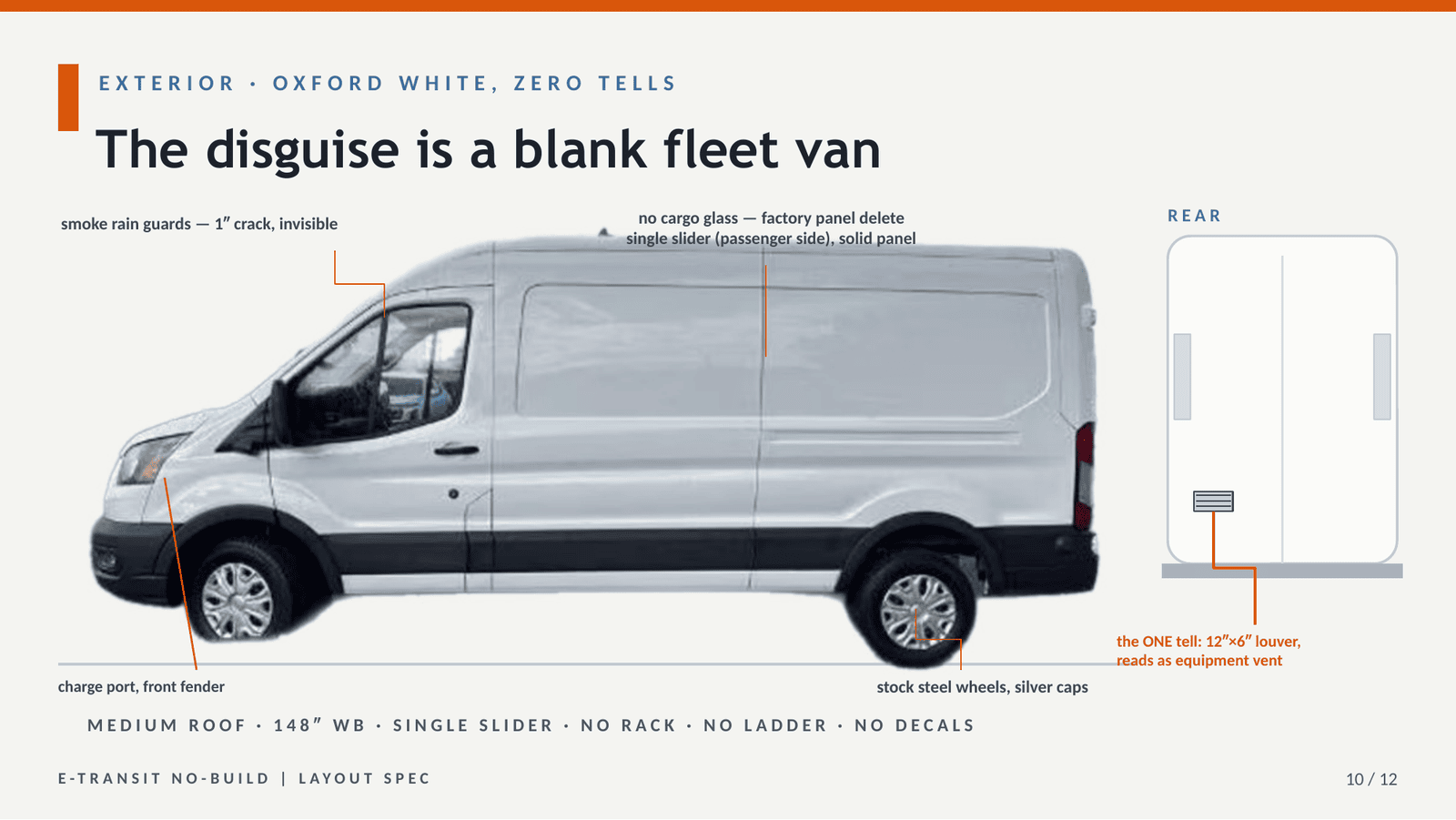
The finished product, from the only angle anyone will ever see it.