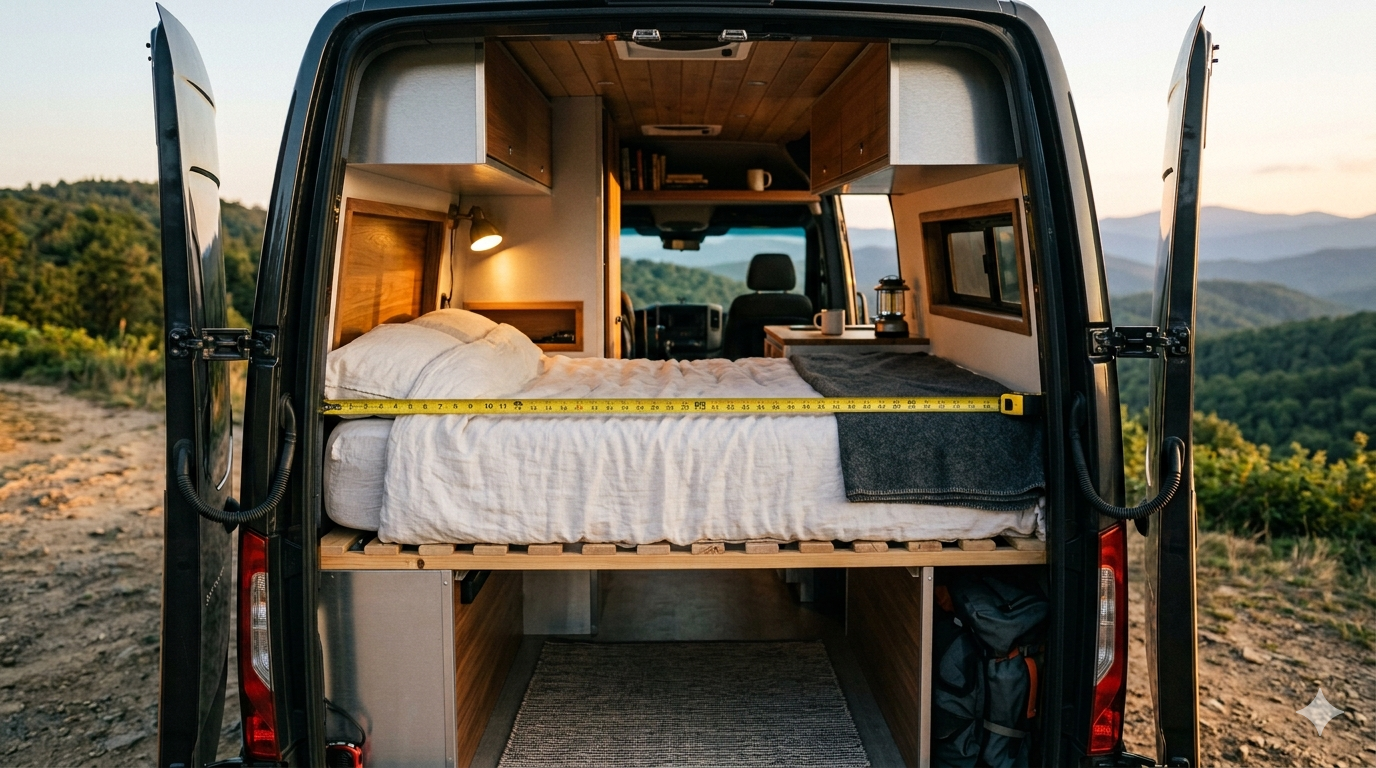
When the bed is too short, nothing else on the spec sheet matters.
I learned this the unproductive way, by spending most of a buyer’s guide ranking fourteen camper vans across thirty criteria before realizing I’d been treating sleep dimensions as a secondary attribute. They aren’t. They’re the binding constraint, the same way fresh tank capacity is the binding constraint for off-grid duration. If you can’t sleep in the rig, you don’t own a camper van. You own a parking pad with curtains.
This post is what happened when I reran the search with one hard rule: 79 inches of usable bed length, minimum. Width didn’t matter. Weight ratings didn’t matter. Off-road kit didn’t matter. Just length. The reweighted analysis killed most of the market in roughly an afternoon and led me somewhere I genuinely hadn’t expected to land.
Why bed length
I’m 6’3”, which is 75 inches. My working rule for camper van shopping is bed length equal to my height plus four inches, which puts the floor at 79 and the comfortable target somewhere north of 80. A 75-inch bed gets me in trouble immediately, because that’s exactly my height with no margin for pillow, posture, or the slight curl most people adopt in their sleep. A 77-inch bed gets me a 2-inch tolerance, which is the kind of margin that disappears the first night after a long drive when I’m too tired to sleep perfectly straight.
Width matters too, but width is where camper vans win. A 56-inch transverse bed (queen-narrow) is fine for a couple if both people aren’t strict back sleepers. The constraint that actually fails buyers is length, and it fails quietly because nobody walks into a dealership and tries to sleep in the bed before signing the paperwork. They sit on it. They photograph it. They imagine themselves in it. None of this catches the problem that they’re 75 inches long and the bed is 76, which leaves a 1-inch tolerance for everything from posture to pillow.
One width caveat worth flagging early. Several of the survivors below use 49” x 79” power-lift beds, which is essentially a generous twin. Two adults can technically share it, but only the way two adults technically share an airline row. If a partner travels with you even occasionally, 49” stops being a feature and starts being a structural problem with the floor plan. The Storyteller’s 56” DreamWeaver doesn’t fix this, but it gets the math closer to “couple-tolerable” than the Tiffin and Revel layouts do.
The honest test is simple: lie down with a pillow exactly how you sleep. If your feet touch the wall, your future self will hate you for the next decade.
The 76-inch wall, and the four vans that just barely clear it
Once the rule was 79 inches, the market collapsed. The endemic length in this segment is 76 inches. A partial roll call of vans that miss by three or more:
Pleasure-Way Tofino: 72. Winnebago Solis Pocket 36A and 36B: 75. Airstream Interstate 19: 72. Airstream 19X: 70. Roadtrek SS Agile: 76. Grech Turismo: 76. Thor Sanctuary: 70 to 74 depending on configuration. Thor Talavera 1920: a 51-inch wide bed at 74 inches long, which is its own problem. Coachmen Nova 20D: 75. Coachmen Beyond 22D: 76. Pleasure-Way Plateau and Ascent: 72 to 74. Hymer Aktiv 2.0: discontinued. Jayco Swift 20T: 76. Roadtrek Zion: 75.
Many of these cluster at 76 inches, which felt like a deliberate industry conspiracy until I found the more boring explanation: 76 inches is roughly the longest transverse bed you can fit between the side walls of a standard high-roof Sprinter, ProMaster, or Transit without flares, and most builders don’t add flares because flares add cost and complicate side-mounted accessories.
There’s a second tier that clears 77 or 78 but still fails my 79 floor. The Glampervan ProMaster 136 has a 60” x 78” Murphy bed, which is a beautifully engineered build at the shortest overall length in the survivor pool but one inch short. The Winnebago Solis 59P has a 59” x 77” primary Murphy+ bed and a 52” x 79” pop-top second bed, which means the only way it works for me is sleeping above the cab on the pop-top full-time, and that’s a sleep-position compromise I’m not willing to make. Both fall out at 79.
The vans that did clear 79 inches all share a common engineering trick: side flares that bump interior width by a few inches at bed height, allowing the bed to mount transverse (or in some cases longitudinal-with-flares) and recover the length the standard van loses to its sidewalls. This is the Flarespace approach, originally an aftermarket product that several manufacturers now buy as a factory-integrated component. The trade-off is that flares change the exterior silhouette of the van slightly (you can spot a flared van from the side) and they add several thousand dollars to the build cost.
The vans that survived the 79-inch cutoff:
Tiffin GH1 Adventure Van at 19’6”, with a 49” x 79” power-lift bed and Mercedes Sprinter chassis. Build quality complaints have piled up post-Thor acquisition; Adventure Van Expo observers and owner forums both flag it. Documented throttle limp-mode complaints and a 2.3/5 rating on PissedConsumer.
Winnebago Revel 44E at 19’7”, with a 49” x 79” power-lift bed. Documented common-failure list at winnebagorevelforum.com including PEX leaks, drawer rails, awning recalls, and fuel pump issues. The 2026 MSRP is $261,808.
Jayco Terrain 19Y at 19’7”, with fiberglass side flares and an estimated 78-80 inch power-lift bed (verify against the specific spec sheet for the unit you’re considering). The owner forum thread literally titled “Whatever you do, DO NOT BUY A TERRAIN” should give you pause. Battery caught fire at a dealership in February 2023; warranty department reportedly ignored the issue for seven-plus months. Counter-intuitive design where the inverter must be on for shore charging.
Storyteller Overland MODE Classic / Dark / Beast OG-XO variants at 20’, with a 56” x 79” DreamWeaver bed and Sprinter 144 AWD diesel. Birmingham, Alabama factory roughly 200 miles from my house in Canton, Georgia.
That’s the surviving field. Four platforms, and the three I’m considering seriously (the Storyteller plus the Tiffin and Revel as nominal alternatives) all clear my 79-inch floor by exactly zero. None of them gives me even a single inch of margin. At 6’3” I am using essentially the entire bed in every mainstream production camper van I found that clears my cutoff at all. That is the actual state of the segment.
Re-running the weighted ranking
Once the field was down to four, the comparison started to feel useful. Some of these had multiple trims, and the trim-to-trim differences mattered as much as the cross-platform differences. Storyteller alone has Classic, Dark, and Beast performance trims, each available in OG (stowable bath) or XO (hardwall bath), which produced six SKUs.
I weighted seven criteria across the survivors. Quality at 18 percent, because at this price point you’re buying engineering and you can feel the absence of it. Reliability at 18 percent, because RVs aren’t allowed to fail the way passenger vehicles fail and these segments have well-documented common failures. Service network at 18 percent, because nobody wants to drive 800 miles for a warranty claim. Reputation at 13 percent, because forum sentiment over multiple years tells you something the spec sheet doesn’t. Price at 13 percent, because budget matters but isn’t the lever. Insulation at 10 percent, because four-season capability is a hidden constraint for anyone planning year-round use. Stealth at 10 percent, because urban overnighting and dispersed-camping anonymity are real factors and aggressive overland aesthetics work against them.
This is not a scientific reliability study. It’s a buyer’s-risk screen built from published specs, owner reports, forum patterns, and how much confidence I’d have writing a six-figure check. Read the rankings as one shopper’s calibrated bet, not a population-level reliability dataset.
The results didn’t flatter the conventional wisdom.
| Rank | Van | Score |
|---|---|---|
| 1 | Storyteller Classic MODE OG | 7.40 |
| 2 | Storyteller Dark MODE OG | 7.18 |
| 3 | Winnebago Revel 44E | 5.44 |
| 4 | Tiffin GH1 | 5.01 |
| 5 | Jayco Terrain 19Y | 3.00 |
The Revel was the surprise. It’s the rig everyone in the adventure-van segment defaults to when they hear “AWD Sprinter that fits dispersed sites.” But when you actually weight reliability against documented failures, service network against owner reports of warranty runarounds, and reputation against the volume of common-failure forum threads, the Revel can’t carry its own marketing. The Tiffin GH1 had similar problems: a beautiful product on paper, with a dealer base undercut by post-Thor-acquisition QC complaints. The Jayco Terrain wasn’t even close. When the loudest voice on the owner forum is an 1,800-mile drive to the factory ending with a battery fire, the rig isn’t a contender.
Storyteller climbed to the top because it doesn’t lose meaningfully on any of the seven criteria. It’s the only one in the field where the build quality, reliability data, service network, and reputation all clear a high bar simultaneously. Not the cheapest, but not absurd. Not the stealthiest, but the Classic and Dark trims are subtle enough for parking-lot anonymity. Not the most insulated, but the polymer blend handles three-season comfortably with shoulder-season margin.
It also helps that Storyteller is the only one of the four where the spread between the published spec and the real-world owner experience runs in the right direction. With the Revel and the Tiffin and the Terrain, owners report worse outcomes than the marketing suggests. With Storyteller, the inverse is true. Owners describe the build as overengineered relative to the price point and the support network as more responsive than the warranty document promises.
Discovering Storyteller (or: how I’d been ignoring the right answer)
I’d been vaguely aware of Storyteller for years without paying real attention. They came up in the previous buyer’s guide as the high-end overland pick for the Beast MODE archetype, but I’d treated them as a niche luxury option rather than as a serious comparison set. The 79-inch test changed that. With the Revel and Tiffin demoted on reliability grounds, Storyteller wasn’t just one option. It was the only candidate in the field where the long bed, the four-season build, the service network, and the reputation all held up simultaneously.
A few things about the brand that surprised me when I dug in.
The factory is in Birmingham, Alabama, a 200-mile drive from my house. That matters more than people realize. Service problems on a $190,000 vehicle are the most predictable category of pain in this entire purchase, and proximity to the factory shortens every recovery loop. Owners who live near Birmingham report walking warranty work in directly when their dealer can’t get parts.
Storyteller has thousands of vans on the road and a documented owner community organized into nine regional chapters. The forum sentiment is unusual. There are complaints, but the overall tone is closer to “I love this thing” than to the standard RV-forum tone of “everything is broken and the dealer won’t return my calls.” Expedition Portal called Storyteller “one of the best out-of-the-box options” and described owner enthusiasm as “cultish.” I take “cultish” as a feature when it correlates with a low common-failure list and a manufacturer that takes ownership of issues.
The pricing model is half marketing, half real. Storyteller advertises “See-Through, No Haggle” pricing, which is partially fiction. The published prices on storytelleroverland.com are MSRP after a standard dealer discount baked in. Real Monroney sticker prices run $70,000-$86,000 above the website’s “starting at” numbers. So when the website lists a Classic MODE OG in the low $190s, the actual sticker is closer to $265,000, and the dealer is moving the unit with a baked-in discount of roughly $73,000. Whether that’s haggle-free or haggle-built-in depends on your priors. In practice, dealers are willing to discount further. I found a 2025 Beast MODE listed at $184,990 with the standing $15,000 factory rebate already applied, which represents an $8,000 discount beyond the website price.
The standing $15,000 factory rebate runs on 2025 144” Classic, Dark, and Beast MODE units through April 30, 2026. That deadline is roughly a week from when I’m writing this. Excludes 2026 model years, GXV products, and Crew/Tour XL variants.
Inside the Storyteller catalog
The lineup is built around three independent axes that combine to produce eight SKUs total.
Axis one: chassis size. Mercedes Sprinter 144” wheelbase (20 feet overall) or Mercedes Sprinter 170” wheelbase (23 feet overall, 3500XD dually). The 144” is the standard adventure platform. The 170” only comes in two pre-packaged configurations: Tour MODE XL and Crew MODE XL.
Axis two: floor plan. OG (stowable Halo Shower plus a portable cassette toilet, with a GrooveLounge sleeper sofa providing a second sleeping area), XO (BoomBox hardwall wet/dry bath plus a fresh-flush cassette toilet, but you lose the sleeper sofa), or XL (the 170” platform’s TroupeLounge configuration).
Axis three: performance trim, available only on the 144” platform. Classic at base, Dark in the middle, Beast at the top. The trim isn’t badging. It’s substantively different. Classic uses the standard Sprinter suspension and an 8.4 kWh M-Power lithium battery. Dark adds the EVICTUS Advanced Suspension upgrade and doubles the battery to 16.8 kWh, plus Mercedes Premium Exterior Color Options and a blackout aesthetic. Beast adds the more aggressive EVICTUS Prerunner Suspension, an on-board air compressor with front and rear chucks, KC HiLiTES 360-degree lighting, an nVader brush guard, and the Beast Graphics Package. The battery on Beast is the same 16.8 kWh as Dark.
What’s common across every MODE: the Sprinter 2500 AWD diesel chassis (3500XD on the XL), DreamWeaver bed at 56” x 79”, Flarespace Legless Bed Supports, MODEcom 11” touchscreen control system, diesel-fired hydronic heating, diesel-fired continuous water heater with hot-water recirculation, polymer blend insulation, 37-gallon fresh tank, 24-gallon grey tank with heating loop, 1-year/15K-mile Storyteller warranty, 5-year/75K-mile Mercedes Extended Limited Warranty included by Storyteller, and 5-year coverage on the Lithionics M-Power battery.
The XL platform deserves a callout. The Crew MODE XL has the only second-row five-seatbelt configuration with a CosmicShift loveseat plus a removable VanSolo captain’s seat and the LunarLoft 4-season pop-up second bed. The Tour MODE XL drops to four seatbelts and a TroupeLounge configuration optimized for entertaining and touring rather than family hauling. Both XL variants are priced at $254,012 (Tour) and $272,208 (Crew). Both have a 75-inch TroupeLounge bed, which means the XL platform fails my 79-inch test by four inches, not one or two. The 144” platform’s DreamWeaver bed at 79 inches is the only configuration that clears the rule, and even then by exactly zero. The shorter wheelbase has the longer bed because the 144” mounts the bed transverse with Flarespace flares to clear the 79” length, while the 170” XL uses a longitudinal lounge-convertible bed that trades length for daytime convertibility. Counterintuitive, but real.
The pricing structure decomposes cleanly:
| Variant | 2026 Price |
|---|---|
| Classic MODE OG | $192,206 |
| Classic MODE XO | $200,801 |
| Dark MODE OG | $215,108 |
| Dark MODE XO | $222,514 |
| Beast MODE OG | $252,821 |
| Beast MODE XO | $260,803 |
The OG-to-XO premium runs roughly $7,400-$8,600 across all trims. That’s the price of the hardwall bath, and it costs you the GrooveLounge as a backup sleeping area. The Classic-to-Dark premium is roughly $22,000-$23,000, and it doubles the battery, adds the suspension upgrade, and gets you the premium color palette. The Dark-to-Beast premium is roughly $38,000, and it buys you the prerunner suspension, the brush guard, the air compressor, the KC lighting, the MODEular storage, and the Beast Graphics. The biggest functional gain per dollar is unambiguously the Classic-to-Dark jump. The Dark-to-Beast jump is buying off-road kit you’d only use if you’re actually rock-crawling.
The Stealth MODE problem (or: why some of the comparison content online is wrong)
This came up enough during research to be worth flagging. Stealth MODE is dead. It was the blacked-out aesthetic variant from earlier model years and was discontinued after 2024. The Dark MODE absorbed the blackout aesthetic into its design language for 2025 and 2026. If you’re reading older content online that ranks Stealth MODE against current options, that content is referencing a SKU you can’t buy new anymore.
MODE LT (the cheaper Ford Transit-based platform) was discontinued after 2023 with roughly 250 total units built. Used MY2022-2023 LTs are still trading at $130,000-$168,000 against original $171,000 MSRPs, which is exceptional resale retention and a real consideration if you can stomach a discontinued platform with a small parts ecosystem.
The “Stealth at Classic price” recommendations you’ll find on older comparison content are wrong for 2026 buyers. The blackout aesthetic now lives in the Dark MODE at the Dark MODE price point, $215,108 for the OG.
Where I arrived
The ranking pointed to Classic MODE OG. The sweet-spot analysis pointed to Dark MODE OG. The dollar analysis pointed at the 2025 model year with the $15,000 rebate, which closes April 30. So the question I had to answer was: do I take the 2025 Classic OG at $172,321 after rebate (before taxes and fees), or pay the additional $18,422 to step up to the Dark OG at $190,743, which buys the doubled battery and the EVICTUS Advanced Suspension?
The honest answer to “do I need the bigger battery” is: probably not, given my stated rotation. My retirement-era plan is summer in Asheville with private-room rentals, winter in Pensacola with similar rentals, and shoulder seasons in Canton with my parents. In all three locations I’d have shore power most nights. The 8.4 kWh Classic battery is more than enough for the typical use pattern of “drive to a nice spot, park, sleep, drive back to a charging location.”
The honest answer to “do I need the EVICTUS suspension” is: also probably not. I’m not rock-crawling. My version of off-pavement is graded forest service roads to access campsites or music venues, which the standard Sprinter suspension handles fine.
The honest answer to “what are you actually buying with the Dark premium” is: insurance against a use-case shift. If my retirement plan tilts toward more off-grid time than the Asheville-Pensacola rotation suggests, the bigger battery becomes binding. If my shoulder seasons start including hot-climate rotations (Pensacola summer, desert Southwest winter), the bigger battery becomes binding for AC duty cycle. The EVICTUS suspension matters more than I want to admit on long drives, where the better damping reduces fatigue. There’s an argument that the Dark is the right buy specifically because it absorbs ambiguity in the use case.
I’m not finalizing the decision in this post, because I haven’t sat in the driver’s seat yet and I haven’t slept in the bed in a parking lot. Both of those are required steps. I’m narrowing to two SKUs: a 2025 Classic MODE OG at $172,321 after the factory rebate before taxes and fees, or a 2025 Dark MODE OG at $190,743 after rebate before taxes and fees. A motivated dealer could potentially move further; I’m treating that as upside rather than baseline. The closest dealer is Bankston Motor Homes in Huntsville, about three hours from Canton and roughly 100 miles from the Storyteller factory in Birmingham, which makes it the closest factory-adjacent dealer in the Southeast.
A few things I’m not considering anymore:
XL variants. The 75-inch bed kills them. This is non-negotiable.
Beast MODE. The off-road kit is real, but I’m not the buyer for it. Paying $250,000+ to look like an overlander when my actual use case is graded forest roads and parking-lot overnighting is not a use case. It’s a costume.
XO variants. The hardwall bath isn’t worth the second-bed sacrifice for me. The stowable Halo Shower is adequate, and the GrooveLounge backup sleeping area is real value if Jennifer travels along or if a friend visits.
GEAR MODE. Storyteller announced GEAR MODE in September 2025 as a stripped-down sub-Classic entry-level on the same Sprinter 144 platform with a 3.7 kWh battery (upgradeable to 11.2 kWh) and prewired-not-installed AC. Six months later it’s not on the dealer network, not on the official MODE comparison page, and not appearing in any inventory listings I can find. Either it’s been delayed past initial release or quietly shelved. Treat it as not actually purchasable in the current decision window.
Closing
The 79-inch test killed most of the camper van market for me, then surfaced a brand I hadn’t taken seriously, then narrowed me to two SKUs separated by about $18,000 and one engineering decision. That’s a reasonable place to land on a six-week research arc. It’s also a reminder that the binding constraint in any decision is rarely the one that gets the most attention. If you’re 6’2” or taller and you’re shopping a camper van, the bed length question has to come first. Ground clearance, battery capacity, and warranty length are all easier to upgrade aftermarket than to grow your bed by four inches.
Go drive whatever you shortlist. Sit in the seats. Ask a current owner what their fifth year looked like. Storyteller forums are public, the regional chapters meet regularly, and the brand’s owner community is unusually willing to talk shop with prospective buyers. The data only narrows the field. It doesn’t pick the rig.
If you’re shorter than me, the exact cutoff changes, but the method doesn’t. Pick your sleep-length floor first, then eliminate every van that misses it before you fall in love with cabinets, batteries, suspension, or Instagram photos. The painful part of camper van shopping is that the disqualifier is often boring. That doesn’t make it optional.
I’ll be at Bankston Motor Homes in Huntsville with a tape measure soon.
Footnotes
- 2026 Storyteller Overland MODE lineup pricing and specifications. Source: https://www.storytelleroverland.com/pages/2026-mode-vans
- $15,000 factory rebate on 2025 144” Classic/Dark/Beast MODE units through 04/30/2026. Excludes 2026 models, GXV products, Crew/Tour XL. Source: https://www.storytelleroverland.com/pages/what-will-you-do-with-15k
- 2026 Crew MODE XL bed dimensions: TroupeLounge 66.5” W x 75” L. LunarLoft RV Full size. Source: https://www.storytelleroverland.com/pages/crew-mode
- RV Trader macro pricing analysis. 163 Storyteller MODE units listed nationwide; pricing range $154,960-$334,021; average $224,968. Source: https://www.rvtrader.com/Storyteller-Overland-Mode/rvs-for-sale
- Dealer Monroney pricing data showing real MSRP versus see-through price. 2026 Classic MODE OG dealer-listed at $189,206 against Monroney $264,889 (Johnson RV Sandy/Fife). Storyteller’s individual product page shows $192,206 for the same model; both prices are observable in the wild as dealers and the manufacturer don’t always synchronize. 2026 Dark MODE OG dealer-listed at $215,108 against Monroney $301,152.