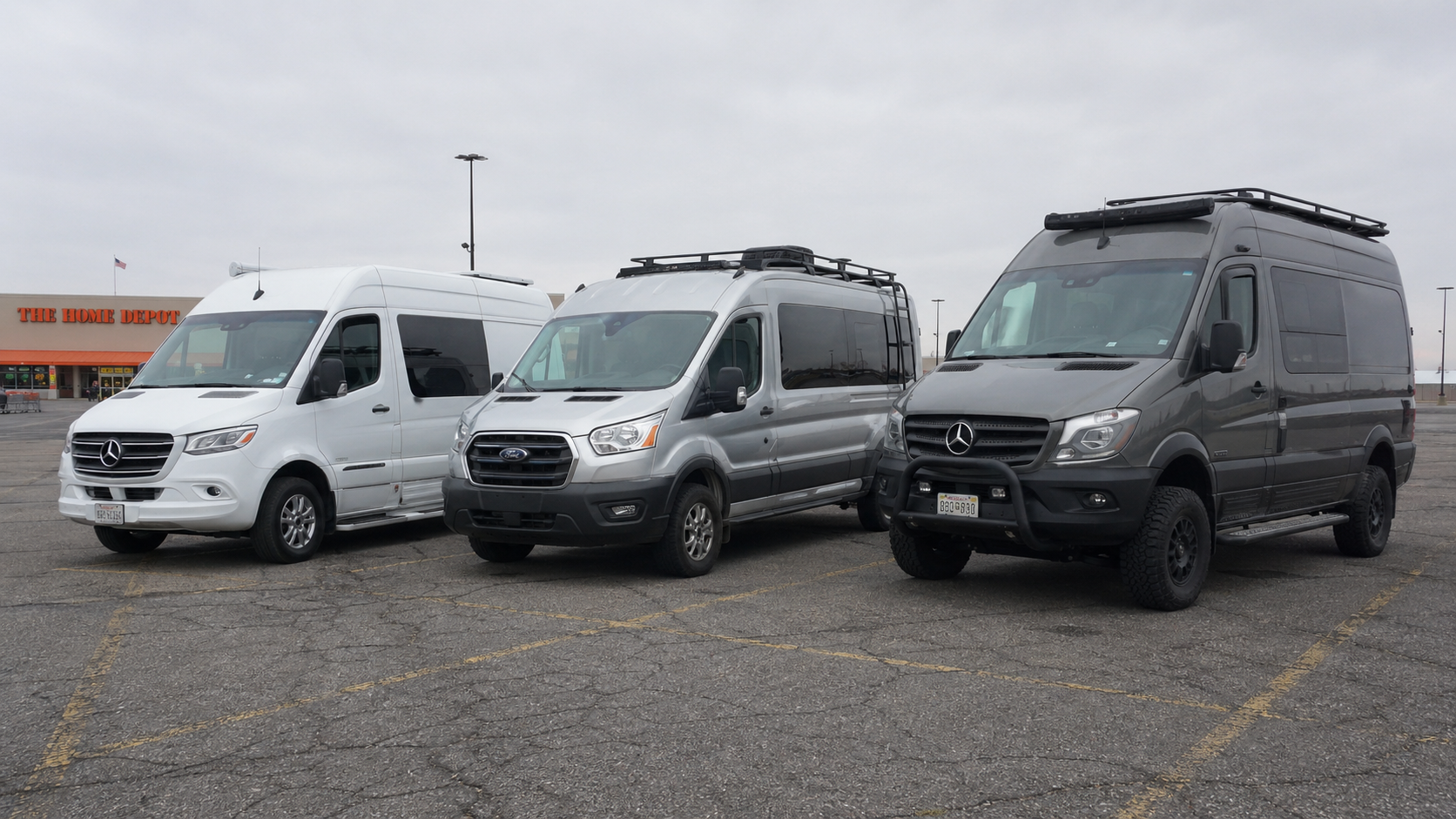
The 2026 Pleasure-Way Plateau TS ranks first for six of seven buyer types in this analysis. By any spreadsheet logic, it’s camper van of the year. It is also a rig you probably should not buy if you actually plan to camp off-grid for more than three days at a stretch.
There is no best Class B. There is the Class B that fits the way you actually camp, and there are thirteen others that will quietly punish you for the next decade if you buy the wrong one. The trouble with Class B coverage online is that almost none of it admits this. Reviewers test a $260,000 van for a long weekend, take photos of the bed deployed, and call it the year’s standout. Forums lock in on whichever rig the loudest evangelist owns. Rankings get scraped from MSRP and length and called comparative analysis.
What follows is a structured run at the same fourteen 2026 camper vans (and a couple of small Class Cs that compete in the same bracket) a serious shopper would have on a spreadsheet anyway, scored across thirty criteria, weighted seven different ways for seven different buyer types, and then read against the actual ownership record on owner forums and recall databases. The data isn’t perfect. None of this data ever is. But it surfaces a few things that a glossy walkaround video won’t, and it kills a few popular myths that the segment has earned the right to lose.
How the rankings were built
Each candidate was scored 1-10 against rubric anchors on thirty criteria spanning ten buckets: cost, drivability, livability, off-grid capability, setup effort, site availability, reliability, service network, resale, and safety. Bucket weights are then redistributed across seven buyer archetypes, so a Boondocker weights off-grid capability at 25 percent while a Snowbird weights it at 5 percent. Each archetype’s weights sum to 100. Researchers pulled spec sheets, dealer listings, owner forums, and NHTSA recall data for every unit, then logged per-criterion rationale and source URLs so anyone can audit the call.
What the methodology is good at: surfacing systematic weaknesses (a 21-gallon fresh tank is a 21-gallon fresh tank no matter how charming the marketing), and revealing what a buyer’s priorities imply when applied consistently. What it isn’t: a road test, a long-term ownership study, or a substitute for sitting in the driver’s seat. It also can’t see future recalls, dealer service quality at your local lot, or the way you personally cook breakfast.
The Pleasure-Way problem (or: why a #1 ranking can lie)
The 2026 Pleasure-Way Plateau TS ranks first for the Weekend Warrior, Vacation Traveler, Snowbird, Full-Timer, Family with Kids, and Solo or Couple Minimalist archetypes in this analysis. Six wins out of seven. By any spreadsheet logic, this is the camper van of the year.
Read the spec sheet honestly, though, and you start to see what’s happening. The Plateau TS has a 24-gallon fresh water tank1, smaller than a standard truck-camper fresh tank and roughly half what a serious off-grid van carries. The primary sleeping arrangement is a power sofa that converts to a queen, with an optional inflatable cab air bed1. There is no permanent always-ready bed. Interior living space is around 85 square feet, single aisle, no slides1. MSRP is $229,310 with a typical transaction near $194,0001.
What the Plateau wins on, and wins decisively, is the basket of attributes the methodology weights heavily for general-purpose buyers: industry-leading 5-year warranty coverage on both the Pleasure-Way coach and the Mercedes-Benz Sprinter chassis1, excellent drivability, strong resale value (used 2019-2020 units retain roughly 70-85 percent of original MSRP)1, and very low common-failure incidence in owner reports. It is also a genuinely beautiful build. Pleasure-Way holds Mercedes-Benz MasterUpfitter status and the coach is hand-crafted rather than line-assembled.
Here’s the catch: those strengths matter most to buyers who plug into shore power most nights and treat the rig like a luxury car that occasionally sleeps two. For those buyers, the Plateau really is a defensible top pick. For anyone who actually wants to spend a week off-grid with a partner, the 24-gallon tank is binding by day three1, the convertible bed becomes a daily logistics chore, and the cost-per-square-foot at $194K transaction is hard to swallow against rigs that cost less and sleep better. Treat the ranking as the honest answer to “what’s the lowest-regret van for someone whose priorities are spread evenly across cost, warranty, drivability, livability, and resale,” not as “best camper van of 2026.”
Three honest contenders
These are the three Class Bs worth profiling deeply. None of them wins a single archetype outright in the rankings (the EKKO comes closest, taking Boondocker). All three are still the right answer for specific buyers in specific situations. The methodology discounts them in ways that a real shopper might not.
Winnebago EKKO 22A: the off-grid pick (with caveats)
A note on category: Winnebago technically markets the EKKO as a Class C because of its Transit cab-over conversion, though the analysis treats it alongside Class B vans because that’s the segment it competes in2. Functionally it’s a 23-foot AWD adventure rig that camps like a small Class C and parks like a tall van.
Specs that matter: AWD Ford Transit chassis, 50-gallon fresh water tank, 320 Ah Lithionics lithium standard (640 Ah optional), 455 watts of stock solar, twin beds with a flex-bed system that converts to a queen, wet/dry combo bath with a clever pivoting wall, cassette toilet (no fixed black tank)2. MSRP is around $179,000 base, with optioned units pushing past $222,000; typical transaction is near $155,0002.
Who it’s for: a couple that takes 5-10 day trips into national forests and BLM land, wants AWD without going up to a Sprinter 4x4 budget, and values stock off-grid kit over interior square footage. The EKKO is the only ranked rig in this set that combines a 50-gallon fresh tank, real lithium and solar, and a footprint compact enough for tight dispersed sites. It ranks #1 within Class B for the Boondocker archetype for exactly those reasons.
Who it’s not for: anyone who wants a permanent queen bed that doesn’t require nightly conversion; anyone with a bad back who finds twin-to-queen rituals tedious; anyone with three or more passengers (the cassette toilet alone makes that brutal); and crucially, anyone who can’t accept buying a unit with a documented multi-year recall history. The EKKO carries five-plus NHTSA recalls covering 2021-2023 production, including a shower-drain overflow onto the inverter (electrical fire risk), cooktop burner tube fracture (propane gas leak), improperly routed 12V wiring (fire risk), seat belt retractor lockup, and blind-spot monitoring failure2. More recent production appears improved, but the pattern is real and worth pricing into the decision. So is the very limited Occupant Cargo Carrying Capacity, around 1,000 pounds with options2, which is easy to inadvertently overload with two adults, full water, and gear.
Honest weakness: the cassette toilet limits black-water duration to about two days for a couple before it needs emptying2, which partially negates the off-grid bragging rights from the lithium and solar. The kitchen is also frankly cramped, with a two-burner cooktop, a microwave, and very little counter space. Reviewers describe cooking as “van-like.”
Approximate transaction price: $155,000 base, comfortably $180,000-$200,000 once optioned the way most owners actually order them.
Coachmen Beyond AWD: the daily-driver pick
If the EKKO is the rig you take into a national forest, the Beyond AWD is the rig you live with the other 350 days of the year. It’s the most car-like Class B in this set: a 22-foot AWD Ford Transit conversion that drives, in the words of one owner forum thread, “like an F-150.” It fits in standard parking spaces, parallel parks without drama, and looks unassuming enough to overnight in a Walmart lot without inviting attention.
Specs that matter: Ford Transit AWD high-roof chassis, around 80 inches of standing headroom (above-average for the segment), 27-gallon fresh tank, single-burner induction cooktop, wet bath with a footprint that owners describe as generous for a Class B, around 195 watts of stock solar, base 330 Ah AGM battery (with the optional Li3 lithium upgrade pushing usable capacity to roughly 640 Ah)3. MSRP runs $160,000-$210,000 depending on configuration; the optioned 22C AWD lists at $207,912 at Best RV Center3. Typical transaction is near $150,000.
Who it’s for: a couple or solo traveler who actually wants to use the rig as a second vehicle, takes shorter trips closer to home or with full hookups, and values urban stealth and parking flexibility above genuine boondocking range. The Beyond is the highest-ranked Class B for the Snowbird, Full-Timer, and Family archetypes after the Plateau, and arguably matches the Plateau’s drivability while undercutting it on price.
Who it’s not for: anyone who reads “AWD” on a spec sheet and pictures dispersed camping in the desert. This is the gap the cache notes call out and that prospective buyers consistently misjudge. The Beyond has roughly 6 inches of ground clearance underbody3. AWD does not equal capability when the floor of the van is closer to the rocks than the bumper of a stock Subaru Outback. One owner sold their Beyond specifically because low clearance made off-grid camping impractical out West3. AWD on the Transit platform is a snow-and-loose-gravel feature, not an overland feature. Treat it that way.
The other honest weakness: a 1-year coach warranty on a $185,000 vehicle is below industry standard3, and base AGM batteries with 195 watts of solar give you maybe two days of self-sufficiency before you need to start the engine to recharge. The Li3 upgrade fixes the second problem and costs accordingly. There’s also a documented pattern of first-year punch-list issues (awning auto-deployment, A/C not working at delivery, multiplex wiring problems) and long warranty service waits at authorized dealers that owners describe as multi-month3.
Approximate transaction price: $150,000 base, $175,000-$195,000 with the Li3 lithium package and the option boxes most buyers eventually want.
Storyteller Overland Beast MODE 4x4 (OG): the premium adventure pick
The Beast MODE is the most capable Class B in this set, and the most expensive. MSRP is $238,587 for the 2026 OG variant; typical transaction with the standing factory rebate is around $223,0004. For that money you get a Mercedes-Benz Sprinter 2500 4x4 chassis, an Agile Offroad / EVICTUS suspension upgrade, BFGoodrich KO2 tires, an on-board air compressor, a 16.8 kWh M-Power lithium system (Lithionics, roughly 290 Ah at 58V nominal, equivalent to 600+ Ah at 12V), a high-output auxiliary alternator with Boost MODE auto-idle recharging, and a build that has genuine credibility in the overland community4.
Who it’s for: a buyer with a real off-pavement use case and the budget to buy the right tool for it. The Beast MODE will reach campsites that the EKKO, the Beyond, and the Revel cannot, and the 16.8 kWh battery alone makes it the most electrically self-sufficient van in the set. Long-term owners report multi-week trips with 90 percent of nights in the van and no shore power4.
Who it’s not for: anyone who can’t honestly account for how often they will use the 4x4 capability. If your boondocking habit is graded forest roads twice a year, the Beast MODE is $80,000-$100,000 of overshoot versus an EKKO or a Revel. It’s also not for anyone who values stealth: the brush guard, KC light bars, roof rack, and exterior graphics make it instantly identifiable as an adventure van, which compromises urban overnighting and makes it a target in some parking lots4.
Honest weaknesses, and there are several. First, the 21-gallon fresh water tank4 is the binding constraint on real off-grid duration regardless of the battery: a couple with showers gets 3-5 days before water becomes the limit, not power. Second, the OG variant uses a HALO folding shower and a portable cassette toilet rather than an enclosed wet bath; the XO variant fixes this with the BoomBox enclosed wet bath, but it costs more. Third, stock solar is 90 watts4. On a $238,000 van. The system is pre-wired for expansion to 325-600W, but you’re paying extra for what should be standard. Fourth, owners report a systemic parasitic battery drain when the van sits unused for more than a week or two, a known coolant-line routing issue on the Rixen diesel heater (manufacturer service bulletin), and three-way warranty accountability gaps between Mercedes, Storyteller, and the dealer when something goes wrong4.
Approximate transaction price: $223,000 for the OG, $235,000-$250,000 for an XO.
The discontinued-model trap: Storyteller MODE LT 4x4
The Storyteller MODE LT 4x4 ranks second across archetypes in this analysis. It does not exist as a 2026 model.
Storyteller paused MODE LT (Ford Transit) production after model year 2023 due to Ford chassis supply inconsistencies; only about 250 total units were ever built5. Storyteller’s entire 2026 lineup is now Mercedes-Benz Sprinter-based. If a dealer is offering you a “2026 Storyteller MODE LT,” they are either selling new-old-stock (not technically wrong, but worth knowing), or they are talking about a different rig.
Why this matters for shoppers: the LT used the Ford Transit AWD chassis and was meaningfully less expensive than the Mercedes-based MODE / Beast MODE lineup. Used MY2022-2023 LTs are trading at $130,000-$168,000 against an original MSRP near $171,0005, which represents exceptional resale retention driven by scarcity and the platform discontinuation. There is a real argument for a used MY2023 LT as the best Storyteller value on the market today. There is no argument for a “new 2026 LT,” because the model doesn’t exist. Buyer beware on listings that imply otherwise.
Skip these
Three Class Bs in this set are difficult to recommend at their 2026 pricing. They aren’t terrible. They’re just losing on cost-to-value for almost every buyer profile.
Tiffin Wayfarer 25LW. Like the EKKO, this is technically a Class C (Sprinter 3500XD cutaway with a single slide) competing in the upper end of the camper-van bracket6. MSRP is $160,000-$175,000, transaction near $150,000. The drivability story is genuinely good (Mercedes chassis, BigFoot auto-leveling, induction cooktop, the best bathroom in this set) and it sleeps four. The problem is reliability. Owner forums document a concerning rate of first-year failures: slide-out motor and electrical connector problems, water pump failures, hydraulic leveler leaks, loose wiring harnesses including a near-fire event, faulty tank sensors, and post-Thor-acquisition fit-and-finish issues6. At loaded weight, owners report as little as 170-700 pounds of remaining capacity to GVWR6. For the same money an EKKO buys better off-grid kit and AWD.
Thor Sequence 20A. MSRP $148,120, transaction near $128,000, the cheapest motorized rig in the set7 and the one where the cost-cutting is most visible. RAM ProMaster 3500 XT (FWD, low clearance), a fiberglass pop-top that owners report leaks on multiple model years, a single-burner induction cooktop, a 72” x 66” pull-out bed with foam owners commonly replace, and a documented pattern of electrical gremlins, generator faults, and plumbing failures across 2021-2024 production7. The 2-year warranty is better than Winnebago’s 1-year, but execution is dealer-dependent and denials are reported. If price is the binding constraint, a used Travato or used Beyond at the same money will likely cost less to own.
Winnebago Revel 44E. This is the painful one, because the Revel has a deserved reputation in the adventure-van community and a genuinely capable platform: AWD Mercedes Sprinter, 19.5-foot footprint, decent ground clearance, 35-gallon fresh tank in the 2025 redesign (a 67 percent increase over prior models), 220 watts of stock solar, induction cooking, no propane8. It’s the only AWD Class B in this set that combines real off-pavement capability with the compact length to fit dispersed sites. So why does it rank #13?
Three reasons, all real. First, MSRP is $261,808 with a typical transaction near $220,0008, it costs more than the EKKO and the Beyond AWD combined, on a per-square-foot basis, and the methodology weights cost meaningfully across every archetype. Second, the coach warranty is 12 months / 24,000 miles, the bottom of the industry8, and owner reports describe difficulty getting even that honored, with Winnebago reportedly blame-shifting RV-portion claims to Mercedes. Third, post-COVID depreciation has been brutal: 2023 Revels with original MSRPs of $215,000-$225,000 are listing used at $115,000-$140,000 within two years, a 40-50 percent loss8 that the rankings legitimately punish. Add a documented Timberline 2.0 hydronic system leak history (including a “gushing” leak report on a 2025 unit), plumbing fitting failures, water pump controller failures, and cabinet/trim issues8, and the cost-to-confidence ratio falls apart.
If you are specifically shopping for an AWD compact Sprinter Class B and the Beast MODE is out of budget, the Revel still makes sense. For most buyers who would otherwise be cross-shopping it against an EKKO or a Beyond, the math doesn’t.
By buyer type: the quick-pick matrix
These are the top-ranked Class B for each archetype based on the analysis. A few archetypes have clear winners. Some of them are arguments more than answers.
| Archetype | Top Class B pick | Why |
|---|---|---|
| Weekend Warrior | Pleasure-Way Plateau TS | Best balance of drivability, warranty, low ownership friction, and resale for low-utilization buyers who plug in most nights. |
| Vacation Traveler | Pleasure-Way Plateau TS | Same logic. The 24-gallon tank matters less when most trips include hookups; the Sprinter chassis matters every mile. |
| Snowbird | Pleasure-Way Plateau TS | Reliability and warranty dominate this archetype’s weights. Plateau’s hand-built coach and 5-year coverage are class-leading. |
| Full-Timer | Pleasure-Way Plateau TS | Ranks first by the methodology, but honestly: full-timing in 85 sq ft with a convertible bed is a real lifestyle ask. The runner-up case for the Beyond AWD or the EKKO 22A is strong here. |
| Boondocker / Off-Grid | Winnebago EKKO 22A | The only entry that combines 50-gallon fresh, 320 Ah lithium, 455W solar, and AWD at a price below the Beast MODE. |
| Family with Kids | Pleasure-Way Plateau TS, but honestly: no Class B genuinely fits a family of four. If you have kids, look at Class C or a travel trailer. | The methodology has to pick something. Treat this row as a warning that you’re shopping the wrong segment. |
| Solo or Couple Minimalist | Pleasure-Way Plateau TS | Honest fit: low complexity, no setup, no slides, low maintenance burden. The strongest archetype match in the set. |
If the Plateau showing up six times feels unsatisfying, that’s the methodology being honest about what it weights, and it’s also a fair reflection of the state of the segment: when you stack up everything except off-grid capability, one well-built Sprinter coach with a long warranty really does sweep most buyer profiles. The minute off-grid weight goes up, the answer changes.
Closing
The structured ranking is a useful frame, not a verdict. Go drive whatever you shortlist. Sit in the seats. Sleep in the bed in a parking lot for one night. Ask a Pleasure-Way owner what their fifth year looked like. Ask a Revel owner about their hydronic system. The data only narrows the field; it doesn’t pick the rig. Reweight the buckets to match your priorities and the answer will move. That’s the point.
Footnotes
-
Pleasure-Way Plateau TS cache file. MSRP $229,310, typical transaction $194,000, fresh tank 24 gal, 600 Ah lithium standard, 285W optional solar, 5-year Pleasure-Way Freedom Coach Warranty plus 5-year Mercedes-Benz Extended Limited Warranty. Sources: https://rvs.autotrader.com/rv-research/model-info/2025-pleasure_way-plateau-ts-overview ; https://pleasureway.com/models/plateau-ts-2026/ ; https://www.rv.com/rv/motorhome-reviews/class-b-review-pleasure-way-plateau/ ; https://www.rvinsider.com/Pleasure-way-Plateau-Ts-RV-Reviews ↩ ↩2 ↩3 ↩4 ↩5 ↩6 ↩7
-
Winnebago EKKO 22A cache file. MSRP ~$179K base (optioned units to $222K), typical transaction $155,000, 50-gal fresh, 320 Ah Lithionics standard, 455W solar standard. NHTSA recalls 2021-2023 documented for shower drain overflow, blind spot monitor, 12V wiring, cooktop burner tube fracture, seat belt retractor. Class C classification per Winnebago. Sources: https://www.rvusa.com/rv-guide/2025-winnebago-ekko-22a-class-c-specs-fp12838 ; https://giantrv.com/wp-content/uploads/2024/06/2025-Winnebago-Ekko-MSRP.pdf ; https://dot.report/vehicle/winnebago/ekko/2023/complaints ; https://www.lichtsinn.com/blog/winnebago-ekko-occc-gvwr-and-more/ ; https://thecampingadvisor.com/winnebago-ekko-problems/ ↩ ↩2 ↩3 ↩4 ↩5 ↩6
-
Coachmen Beyond AWD cache file. MSRP $160K-$210K depending on configuration, typical transaction $150,000, 27-gal fresh, 330 Ah AGM standard / 640 Ah Li3 optional, 195W solar, ~6 inches underbody clearance, 1-year coach warranty. Sources: https://coachmenrv.com/beyond ; https://www.bestrv.com/product/new-2025-coachmen-rv-beyond-22c-awd-2634154-13 ; https://www.irv2.com/threads/coachmen-beyond.2002981/ ; https://rvforums.com/threads/coachmen-beyond%E2%80%99s.9307/ ↩ ↩2 ↩3 ↩4 ↩5 ↩6
-
Storyteller Overland Beast MODE 4x4 OG cache file. MSRP $238,587, typical transaction $223,000, Mercedes Sprinter 2500 4x4 chassis, 16.8 kWh M-Power lithium (~290 Ah at 58V), 90W stock solar, 21-gal fresh, EVICTUS suspension, on-board air compressor. Documented battery parasitic drain and Rixen heater coolant line service bulletin. Sources: https://www.storytelleroverland.com/pages/beast-mode-og ; https://expeditionportal.com/storyteller-overland-mode-4x4-review/ ; https://forum.expeditionportal.com/threads/storyteller-overland.249060/ ; https://www.rvtravel.com/rv-review-storyteller-overland-beast-mode-4x4-class/ ↩ ↩2 ↩3 ↩4 ↩5 ↩6 ↩7
-
Storyteller MODE LT 4x4 cache file. Production paused after MY2023; ~250 total units built. Original MSRP ~$171,000; used MY2022-2023 trading at $130,000-$168,000. Sources: https://www.storytelleroverland.com/blogs/news/will-storyteller-overland-continue-building-mode-lt-vans ; https://www.storytelleroverland.com/pages/2023-mode-lt ; https://www.storytelleroverland.com/pages/2025-mode-vans ; https://www.fordtransitusaforum.com/threads/intro-newbie-help-me-decide-between-sto-mode-lt-transit-and-sto-beast-stealth-sprinter.91473/ ↩ ↩2
-
Tiffin Wayfarer 25LW cache file. MSRP $160K-$175K, typical transaction $149,995, Mercedes Sprinter 3500XD cutaway, 32-gal fresh, 200 Ah lithium, single slide, twin beds. Documented post-Thor-acquisition QC issues. Sources: https://www.rvusa.com/rv-guide/2025-tiffin-wayfarer-25-lw-class-c-specs-tr65881 ; https://www.irv2.com/threads/wayfarer-owners-what-problems-have-you-had.1904384/ ; https://www.rvinsider.com/Tiffin-Wayfarer-RV-Reviews?make=Tiffin&model=Wayfarer ; https://www.rvtravel.com/rv-review-2022-tiffin-wayfarer-25rw-1766/ ↩ ↩2 ↩3
-
Thor Sequence 20A cache file. MSRP $148,120, typical transaction $128,000, RAM ProMaster 3500 XT chassis, 30-gal fresh, 200 Ah lithium, 100W solar, fiberglass pop-top, 2-year Thor coach warranty. Documented pop-top leaks, electrical issues, generator faults across 2021-2024 production. Sources: https://www.rvusa.com/rv-guide/2025-thor-motor-coach-sequence-20a-class-b-specs-tr66317 ; https://www.thormotorcoach.com/sequence/floor-plans/20a ; https://www.thorforums.com/threads/2022-thor-sequece-20a-electrical-gremlins.2194158/ ; https://www.rvinsider.com/Thor-Sequence-20A-RV-Reviews?make=Thor&model=Sequence+20A ↩ ↩2
-
Winnebago Revel 44E cache file. MSRP $261,808, typical transaction $220,000, Mercedes Sprinter VS30 AWD, 35-gal fresh (2025 redesign), 165 Ah at 51.2V Lithionics (~330 Ah 12V equivalent), 220W solar, 12-month/24,000-mile coach warranty, no propane. Used 2023 units listing at $115K-$140K against original $215K-$225K MSRPs. Sources: https://www.rvusa.com/rv-guide/2025-winnebago-revel-44e-class-b-specs-tr65300 ; https://www.lichtsinn.com/blog/new-2025-winnebago-revel-key-features/ ; https://www.winnebagorevelforum.com/forum/revel-tech/problem-solving-owners-helping-each-other/other-revel-problems/2087-top-5-common-problems-with-revel ; https://www.fordtransitusaforum.com/threads/revel-prices-have-collapsed.96773/ ; https://thevansmith.com/blogs/beginners-guide-to-the-vanlife/is-the-winnebago-revel-worth-it-a-colorado-builders-honest-assessment ↩ ↩2 ↩3 ↩4 ↩5